

A guest post by Nazanin Shahrokni, Associate Professor of International Studies at Simon Fraser University and author of Women in Place: The Politics of Gender Segregation in Iran.

“Our neighborhood was hit. But we are alive.”
“We are alive.” I woke up to this message from my friend in Iran.
A message like that rearranges the meaning of language. Alive becomes a threshold, a daily confirmation, a fragile accounting.
This is the friend with whom I have walked under falling snow from Velenjak, where our university was, to Shahrak-e Gharb, driven the long arteries of Tehran from Seyyed Khandan to Chizar, where she trained in volleyball, and spent hours in cafés talking about everything and nothing. We browsed second-hand books along Enghelab Avenue, played badminton in parks that are now cratered, and watched volleyball matches at the 12,000-seat Azadi Stadium—men’s matches. Later, women were barred from entering. Now the stadium itself lies bombed, powdered—another force of erasure layered onto the earlier denial of access.
All of those hours now scatter like dust.
Now Tehran burns.
The city that some members of the diaspora had long called “a ruin already” (خرابشده) was never rubble. It was suffocating at times, chaotic, uneven, but stubbornly alive—restless, inventive, full of motion and possibility. War has a way of fulfilling fantasies of destruction that language alone never could. The bombs are doing what rhetoric once claimed. Turning neighborhoods into the ruins others had already imagined.
And when the dust settles, reconstruction will be claimed as someone’s victory—often by those responsible for the destruction.
She sends me texts—short messages arriving between blasts. With each image she sends, another fragment of the city reaches me. I feel the attacks viscerally—the cracking of walls, the shattering of windows, the breaking of bricks under the force of the blast. Distance collapses into sensation.
She tells me she knows what distance does to me. But I don’t feel distant.
Distance is what I feel from the immediate geography around me. Distance from those who speak of war as if it were pollution carried by the wind—an unfortunate externality. Distance from those who refer to people like my friend, their own friends, as collateral damage, as necessary pain—shrugging their shoulders and repeating that tired phrase: we are left with no choice. From those who hide behind the sterile language of “targeted strikes” and “surgical removal,” as if violence could ever be clean.
Every day she writes to lift my spirits. The irony is unbearable. I am the one sitting on my balcony, watching the sun slowly dissolve into the Pacific Ocean—that patient fading of light, the gentle transition from evening into night. She is the one standing on hers, watching a different light: the violent illumination of the sky when a strike tears through the darkness and, for a moment, turns night into day.
And still, she reassures me.
“Do you want me to call your aunt?” she asks.
I have become a burden I cannot even lighten. She is thinking about how she could help me. My aunt. Of course. She had two surgeries on her eyes, only weeks before the war began. I cannot reach her. The internet is shut down. Another kind of lifeline denied. A vein deliberately clogged by the machinery of authoritarian control.
My friend writes that my aunt is fine. “Still in Tehran.”
I try not to micromanage from afar, but the question slips out anyway: “Why are you all still there? During the twelve-day war in June most of you left for surrounding towns”— places spared, for the moment, by the uneven patterns of bombing.
“It’s different now,” she replies.
When you believe something is temporary, you leave. When war becomes a recurring feature of life, you stay. You continue as if everything is normal. You follow routines. It is the continuity of these routines that allows you to live in the middle of war. You want to preserve the semblance of a life untouched by war.
But then you turn and see the crossed tape on your windows, meant to keep the glass from exploding inward. And you know: nothing about this is ordinary. People greet each other with a joke—“Haha, you’re still alive?”
When survival becomes the joke, ordinary life is already gone.
You stay because the city is still your life—your work, your family, the streets that know your footsteps. Leaving would mean letting the war take that, too.
And I think of what that life looks like for the young—I think of her son. A bright young man now, attending Iran’s top technical university. This is not the life she imagined for him.
The first year her son entered university, COVID arrived and the campuses closed. Two years later came the Women, Life, Freedom uprising—arrests, killings, the closing of campuses. Just as he was graduating came the twelve-day war—the campuses closed again. Then the January uprisings—arrests, killings, the closing of campuses again.
And now, as he prepares for graduate school: another war.
Tehran is the city that holds this young man’s stories. Where he slowly knitted dreams of a future—only to watch those dreams unravel each time someone dares to shout the simplest demand: life. A decent life. Freedom—freedom simply to live a “normal life”. Dreams unknitted again and again while he watches, stunned, as those who demand life are beaten, arrested, or silenced. Universities close once more. Futures suspended.
What can I do for him? Nothing.
Later, scrolling through my phone, I come across an image someone has posted on Instagram. The screen is split in two. On one side: Tehran burning after the US-Israeli attacks. On the other: rows of corpses wrapped in body bags, waiting to be identified by family members during the January uprisings.
 “If you begin to doubt—even for a moment—look at the image on the left,” the caption reads—an appeal to silence anti-war hesitation by invoking the memory of those killed in earlier protests.
Why have we built a world on such binaries? Why must one violence cancel another? Why must we choose between two horrors rather than see both as evidence of the futility of violence itself? These are not separate things, but points along the same continuum. Both shrink the horizon of imagination—and of movement. Each forecloses another possibility.
“We’re doomed either way,” my friend says.
I scroll further down. Someone has shared a short video of a baker whose brother was killed in Israeli strikes from June 2025. A baker with a thick mustache. Sweat beads on his forehead, though it is winter. His hands move with the practiced rhythm of repetition: flattening the dough, stretching it across the wooden paddle, sliding it into the tanour, the deep clay oven where flatbread bakes against its burning walls
He turns his face away from the camera, uneasy with its presence. The whole scene could feel staged—another clip meant to display national resolve for the cameras. The baker says he will not stop baking bread for people.
“مگه مردم نون نمی خوان؟ مگه مردم گناه کردن؟”
“People still need bread,” he says. “Why should they suffer?”

Maybe the video is staged. But the care in his eyes is not. Perhaps this is how propaganda works: capturing genuine acts of care and packaging them into a narrative of national resolve.
But care has its own trajectory. Care shrinks distance.
I feel closer to that baker—whom I have never met—
than to Alicia, who hands me my coffee at the neighborhood café here in Vancouver.
I keep scrolling. I should stop. But I don’t. Someone has posted a photo on Twitter of yellow jasmines in his cousin’s garden that had turned black.
“Jasmines have turned black,” he wrote. I broke. The poetics of war sometimes arrive quietly, through a single line like this. A flower whose color has been burned out of it.
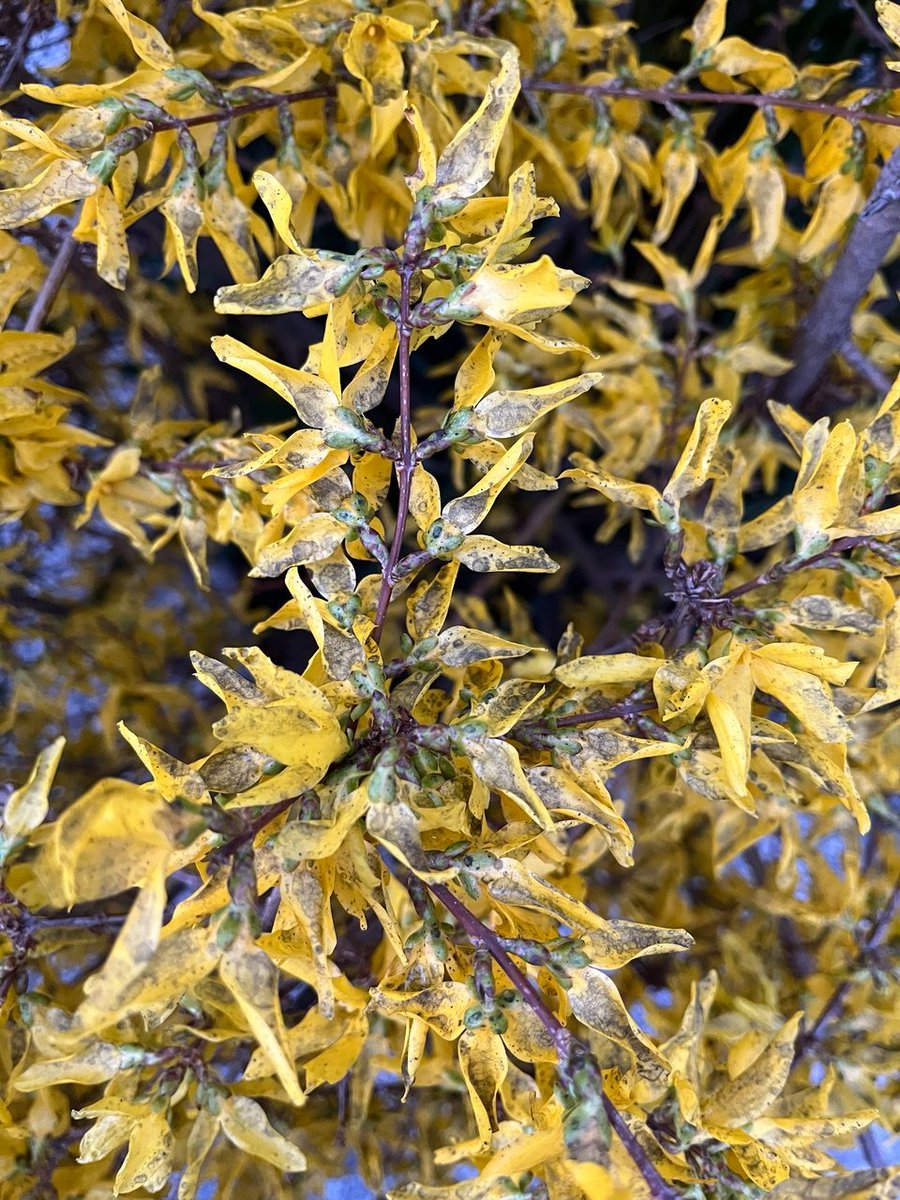
People are dying under bombs, their bodies shattered, their psyches scorched—and I am sitting here on my balcony facing the vast blue of the Pacific Ocean fixated on jasmines that are no longer yellow but black. How pathetic!
My grandmother kept yellow jasmines in a large terracotta vase on her balcony in Tehran. I loved the contrast: the deep yellow petals against the red velvet Turkmen rug she had spread beneath them.
That rug is now in my office.
The jasmines are gone. And so is my grandmother.
War loosens the past. The dead return in small things: a flower, a rug, a color.
Another image was circulating on Instagram: flames coursing through the joobs—the narrow canals that thread their way through Tehran’s streets. Those joobs are everywhere in our memories. They shape the city’s rhythm. Water runs quietly through them, feeding the plane trees that line Tehran’s long boulevards.
After the oil depot was struck, those canals began carrying something else. Burning oil slid through the channels that once carried water. It was as if the city’s veins had filled with fire. Tehran itself seemed like a body being charred from within.

What are we feeding those trees now?
Soon they will be green no more. Though perhaps they have not been green for a long time—slowly suffocated by pollution, neglect, and decades of failed stewardship.
The fragile colors of ordinary life—the small forms of life that cities depend on.
My friend writes to me again:
“We are alive, Nazanin.
Tehran is dying.”


