


A guest post by Mahdi Chowdhury, a writer, researcher, and doctoral candidate at Harvard University. He is presently writing a dissertation on Indian Ocean Islam and British imperialism.
***
“What should Indians try in Iran?“
“Ghormeh sabzi,” the Iranian sailor says, smiling without hesitation. He adds:
“Biryani is so spicy,” gesticulating tears in his eyes. “I am crying at the table.” At this, the Iranian sailor and the Indian interviewing him burst into laughter.
Their exchange was filmed in late February during the International Fleet Review and MILAN 2026, a massive multinational parade and exercise in the Bay of Bengal. It is a light-hearted conversation and yet it evokes some of the oldest promises of naval life: the opportunity to see the wider world, the fraternity of maritime society, the experiences through which young men and women become someone. The sailors take selfies, group photographs, videos of the procession; their sojourn in India is memorialized in pressed uniforms and smiling conversations, the awkward signs of youth inscribed in their manners and gestures. These images would become the last records of their young lives, faces that would never have the chance to grow old.
On March 4, 2026, on their voyage home, the Iranian frigate IRIS Dena was ambushed and torpedoed by an American submarine off the coast of Sri Lanka. Within moments, approximately 180 people on board were thrown into the sea. As the Iranian sailors struggled to stay alive in deep waters, the Dena sent out a distress call pleading for help. In abject disregard of historic maritime custom to assist and rescue survivors of shipwrecks, including wartime enemies, the American vessel ignored their calls and sped away.
Only days prior, these drowning cadets marched in the same parade with their US Navy counterparts. The US would have known the Dena was defenseless because the parade was a peacetime mission and participants were required to be unarmed. The Sri Lankan Navy became the primary search-and-rescue operator, recovering 87 corpses and 32 survivors.
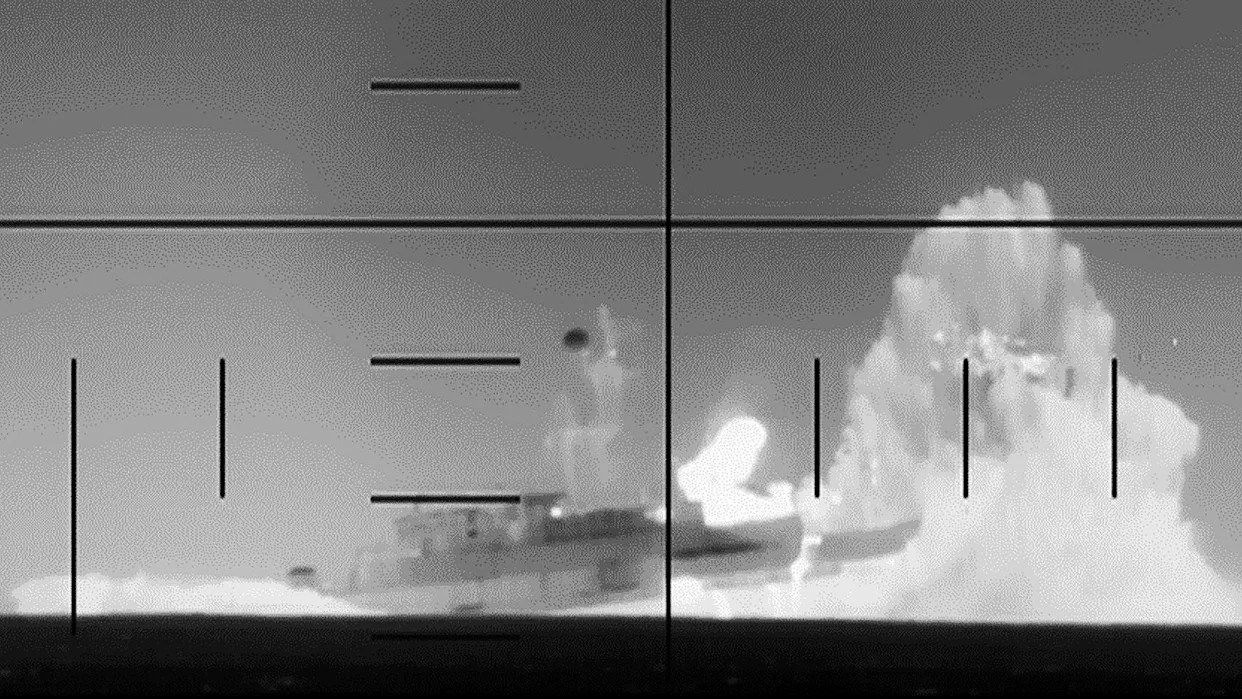

“Quiet death,” boasted the self-styled ‘Secretary of War’ Pete Hegseth. Exhibiting a video of the attack, he praised it as “an incredible demonstration of America’s global reach.” The Unclassified periscope footage offers a now-familiar thermal gaze: a grainy black-and-white heat signature recording from the vantage of a targeting system.
A burst of mist and the iron vessel flops with surreal softness like a cake; we have to remind ourselves that under the white oceanic bloom, this is a state-sanctioned snuff film. This evidentiary optic once appeared in the scandalous drone footage released by WikiLeaks, but the visual grammar of disclosed war crimes has transformed into an aesthetic of trophy-making.
The same spectacles were made of the bombardment of Yemeni tribesmen in Hodeidah and Colombian fisherman in the Caribbean Sea, demonstrating what Greg Grandin argues is the migration of a particular doctrine of force: “The Trump White House is bringing the logic of Gaza to the Caribbean—the use of disproportionate, high-tech violence to kill defenseless civilians with impunity, justified by the broadest imaginable definition of self-defense.”
A spasm of studious, technicality-scraping legal arguments were quickly penned by academics from the U.S. Naval War College and Harvard Law School to legitimate this assault—yet, when asked what justified this freakish decision, Trump answered playfully:
“It’s more fun to sink them.”
***
The joint US and Israeli war on Iran is archipelagic. It stretches across the aerial-maritime anatomy of the United States’ “empire of bases.” It is underwritten by a vision of a West Asia subordinate to the “political economy of the Abraham Accords”: a frictionless geopolitical surface dominated by an alliance of American, Israeli, and Gulf capital—and which has found its most annihilationist expressions in Gaza. The sinking of the Dena is the farthest delimitation of this war’s fronts. With the Strait of Hormuz as its Archimedean point, it alerts us to the maritime centrality of a conflict that leverages the world-ocean in matters of defence, assault, and attrition.
The ambush of the Dena, returning peacefully from an Indian naval parade, has moreover exposed the limits of Prime Minister Narendra Modi’s muscular nationalist claim that the Indian Navy is the “guardian of the Indian Ocean.” Whether New Delhi’s response is evasive, complicit, or merely cautious, the episode reveals an uncomfortable truth: the Indian Ocean is not governed primarily by the states or societies that live along its shores.
Over three billion people inhabit the Indian Ocean rim, one-third of humanity, and yet the decisive power in its waters lay with an external, unaccountable hegemon in Washington. How did the Indian Ocean, this dense, interconnected, millennia-spanning continuum between Africa and Asia, become a geography of unilateral US dominance?
In Sukarno’s address at the Bandung Conference of 1955, the Indonesian president dwelled on anxieties about the sea as he spoke to leaders from across the newly-decolonized states of Asia and Africa. His tenses were unstable, shifting between past, present, and future. The seas do not safeguard us, he argued, but serve as the liquid “life-line” and “main artery of imperialism.” The Portuguese, Dutch, and British were all transoceanic empires whose naval supremacy “pumped the life-blood of colonialism.” His uncertainties hung in the air: what is to prevent another such empire, a neocolonialism after independence? And what to make of oceanic domination in an age of atomic warfare and industrial pollution? “Even if we ourselves escaped [contamination] lightly,” Sukarno added, “the unborn generations of our children would bear on their distorted bodies the marks of our failure to control the forces which have been released to the world.”
Postcolonial thinkers augured alternative visions of the Indian Ocean. Non-Aligned intellectuals and statesmen, such as K. M. Panikkar in Asia and Western Dominance (1953) or Clovis Maksoud in The Arab Image (1963), located themselves at the conjunctural end of the “Vasco da Gama epoch” of Asian history, referencing the Portuguese conqueror. The politics of the new age sought to reverse the colonial separation of Third World societies and the militarized, competitive, hierarchical logics of empire. The Indian Ocean was rediscovered as a space of worldmaking and redemptive possibility.
To be sure, the ‘Vasco da Gama epoch’ simplifies the history of the Portuguese empire and overstates their overall disruption to the Indian Ocean. But as a moral chronology, it brought into relief an idyllic sense of the precolonial Indian Ocean—and critiqued imperialism as a four-century long interregnum of what Engseng Ho called the “marriage of cannon to trading ship.” The Indian Ocean was remembered as a peaceful, creolized counterpoint to exclusivist European notions of race and nation.
In this reading, the Indian Ocean was the original cradle of globalization, an efflorescent “world-system” that arched from Arabia to China without a dominant centre. It was not absent of violence and hierarchy. But the imaginative heart of the Indian Ocean retained its status as a pluralistic, exchange-based creation by and for Asians and Africans, a Third Worldism before such an essentialism was needed. The Indian Ocean posited a diasporic, hybridized communal form that stood in opposition to ‘White Australia’ and ‘apartheid South Africa,’ suggested Mauritian historian Auguste Toussaint. The Ocean’s promise was that of a shared Afro-Asian commons, a polycentric world order space defined by relationality, not domination.
***
Decolonizing visions collided with the geopolitical realities of the Cold War. As the United Kingdom patchily withdrew from its holdings ‘east of Suez,’ the United States moved into the vacuum. The rise of American power in the Indian Ocean was legitimated by paranoia of a Soviet search for a “warm water” port. However, it was also an extension of America’s blue water empire forged after 1898, incorporating Cuba, Puerto Rico, Hawaii, Guam, and the Philippines.
Senator Albert J. Beveridge’s “In Support of an American Empire” (1900) urged the widening of America’s frontiers and the creation of a thalassocratic polity. It was Manifest Destiny transposed to the “geography of the world.” At the twilight of “the Indian wars,” the Philippines opened a new frontier. In justification of the US military’s atrocity-filled ‘counterinsurgency’ against Filipino nationalists, courting contemporaneous analogies to Wounded Knee, Beveridge furnished his speech with a potent dose of civilizing mission. Indeed, Rudyard Kipling’s “The White Man’s Burden” was penned in admiration of the US colonization of the Philippines.
After the Second World War, the occupation of Japan and the mobilization of the Korean War—wherein, the US dropped over 635,000 tons of bombs on the peninsula—consolidated the Seventh Fleet within the US Navy. This evolved into the hemispheric force that is the present-day Indo-Pacific Command. These naval leviathans were repeatedly deployed by Nixon-Kissinger against the North Vietnamese and to enclose the Bay of Bengal in support of Pakistan’s genocidal war in 1971 .

In the western Indian Ocean, the US strengthened authoritarian, anti-communist partners while formalizing containment through alliances like the unsteady Baghdad Pact of 1955. After the CIA coup d’état against Mohammad Mossadegh in 1953, on account of his attempt to nationalize the Anglo-Iranian Oil Company, Iran became a significant node in this security architecture. The US aided the Pahlavi regime in building the most technologically advanced military in the ‘developing world,’ including a carte blanche pathway for nuclearization.
The historian Ervand Abrahamian noted arms dealers joking “that the shah devoured their manuals in much the same way as other men read Playboy.” Massive arms sales from the US—fighter jets, naval destroyers, nuclear submarines—transformed Iran into an outpost capable of projecting force across the Persian Gulf and the Indian Ocean.
Situated within striking range of the entire Indian Ocean littoral, one finds the most ominous, emblematic microcosm of American empire: the island of Diego Garcia. A coral atoll in the Chagos Archipelago claimed by France and later Britain from the eighteenth century onward, it was populated by plantation slavery and indentured labour.


During the Cold War, Washington eyed Diego Garcia as an ideal base through which the US could manifest—in the words of the architect of the island’s seizure—an “Indian Ocean Monroe Doctrine.” Between 1967 and 1973, after leasing the island from the UK and falsely claiming to the United Nations that the archipelago had “no permanent population,” the British and Americans jointly expelled thousands of Chagossians from their homes with no right of return.
“There are times when one tragedy, one crime, tells us how a whole system works,” narrates John Pilger in his documentary on Chagossian expulsion. The tireless activism of this small community helped push toward a British transfer of sovereignty—albeit, with controversy, to Mauritius and not to the Chagossians themselves. Even so, the archipelago’s strategic concerns continue to override human rights and international law. Trump criticized the UK’s decision this January as “an act of GREAT STUPIDITY” and later in February stated that irrespective of the decision: “[s]hould Iran decide not to make a Deal, it may be necessary for the United States to use Diego Garcia.”
On March 21, 2026, the UK Ministry of Defense reported two failed ballistic missiles fired toward Diego Garcia. Iran has since denied the allegation. Whether truth, propaganda, or the fog of war, the idea alone of Diego Garcia being a target signifies a historic fracture: the first time this looming fortress has been acknowledged, contested, and made to seem even slightly vulnerable. Between allegation and reality, this is a momentous confusion, one that tears into the psychological fabric and spectral menace that is Diego Garcia.
In Diego Garcia, we find a metonym for the entire militarization of the Indian Ocean. It is an emblem of colonial passover from British to American imperialism, the engineering of terra nullius, and the total dehumanization of a people with no home other than the sea.
Against militarized currents, the UN adopted a resolution in 1971 declaring the Indian Ocean a “Zone of Peace.” Emerging from conversations among the Non-Aligned Movement, the proposal was brought by Sri Lanka. It called for the basin, its airspace, and the ocean floor to be designated as a demilitarized region, urging (a) the de-escalation of current military hostilities and (b) eliminating present bases, installations, logistical supply facilities, and nuclear weapons.
Littoral states were to cooperate in making the ocean a site of postcolonial reconstruction. Countries such as China, India, Indonesia, and even Iran voted in favor of the resolution, while the United States, Israel, and South Africa abstained. It passed in the United Nations General Assembly.

But the US ignored the resolution. Instead, it expanded its military control. The Oil Embargo of 1973 augmented the conviction for greater command over the passage of petroleum. The US cycled through new fronts and idioms: the ‘Arc of Crisis’, the Soviet invasion of Afghanistan, the Iraq Wars, ‘Somali piracy,’ AFRICOM, the Global War on Terror, and to be sure, the present ‘rise of China’ as a global, amorphous spectre. Foreign policy appeals for a post-Middle East “pivot to Asia” is misleading: from an oceanic perspective, the containment of China is not a separate project but a part of a unified, criss-crossed field of hegemony stretching from Bahrain to Okinawa, from Fifth to Seventh Fleet.
The world-ocean is the heart of our planetary equilibrium. America’s empire of bases acutely devastates maritime ecologies. Massive quantities of sewage, fuel residues, PFAS chemicals, coral dredgings, disruptions to mariculture, and sonar pollution are built into prosaic base operations. More severe are the impact of munitions, herbicides, burn pits, oil spills, and the carbon costs of war mobilization on an industrial scale. The first two weeks of the war on Iran emitted more than five million tonnes of greenhouse gases—or, the annual equivalent of a “medium-size, fossil fuel-intensive economy such as Kuwait.” The apocalyptic sky-blackening ignition of petroleum depots and acid rain over Tehran, Narges Bajoghli suggests, “may be the largest release of petrochemical toxins over a civilian population since the Iran-Iraq War.” This particular moment—and the century-long militarization preceding it—manifests Sukarno’s fears of a poisoned planet left to our ‘unborn generations.’
This dire state of being is not solely an outcome of US imperialism. Newly independent states did not transcend the constraints of the territorial sovereignties they inherited. Whereas empires thought in “expansively maritime and aerial” terms, observes Enseng Ho, postcolonial ambitions tended to remain “narrowly terrestrial.” Newfound states became gatekeepers of bordered territory rather than stewards of oceanic connections.
Were these failures sewn into the fabric of the Bandung Spirit? A conference that legitimated and empowered not the popular societies of the Third World but the gate-keeper states that oversaw them? Even solidaristic initiatives by Indonesia in 1955 or Sri Lanka in 1971 are contradicted by these governments’ violent coterminous conducts in West Papua and Tamil Eelam. Yet, as the legal historian Samera Esmeir argues: while Bandung “did not transcend the grammar of the sovereign state,” it still “manifested the possibility of another collectivity or being-in-common, bringing back forms of life that were once possible in the Indian Ocean…”
***
The drowning of Iranian mariners was made possible by an asymmetrical US capacity to strike anywhere at any time, without liability or humanitarian sensibility. Is it an exceptional aberration or a predictable consequence of a geography dominated by US militarism?
Nothing in the region approaches the US in material, technological, and militaristic terms—nor in its ideological transplantations of Frontier, Manifest Destiny, and Monroe Doctrine. In its century-long tenure in these seas, it has depopulated societies, facilitated total wars, propped up autocratic regimes, transferred mass quantities of arms, sullied ecologies, and wielded firepower without constraint or accountability.
To demand the demilitarization of the Indian Ocean is to affirm the primacy of littoral African and Asian societies to determine their own destinies, to meet within their own oceanic commons. “[T]he sea is our pathway to each other,” wrote the great Pacific intellectual Epeli Hau’ofa—and “no people on earth are more suitable to be the custodians of the oceans than those for whom the sea is home.” The time has come to evict US militarism from the Indian Ocean and work toward a genuine Zone of Peace.
The demilitarization of the Indian Ocean may sound utopian. It is, in fact, the only reasonable demand commensurate with the existential stakes at hand. Ecological custodianship or catastrophe. Being-in-collectivity or in domination. The submarine darkness that covers the Dena is a bookend for a century-long history of dispossession and hegemony. Against ‘quiet death,’ an alternative, demilitarized, planet-preserving order in the Indian Ocean must emerge.


