


برای ترجمهی فارسی اینجا کلیک کنید
A friend recently shared two anecdotes from his trip to Iran with me that deal with race and skin color in the Iranian context. In Persepolis, which is located in southern Iran, darker features are more prevalent than in northern Iran. During a trip to the city, he and his Tehrani friends were surrounded by local schoolchildren yelling “hello!” and other basic English phrases. Even the teacher leading the group spoke to my friend in stilted English, asking where the group was from. The children were bewildered to learn that the light-skinned tourists (including one with red hair) were, in fact, Iranians and not Europeans. Conversely, the children had a darker skin tone that in Tehran might be seen as foreign or “Afghan.”

The second anecdote took place in Tehran. While walking down a busy street, my friend and his cousin noticed a man with darker skin. My friend’s cousin insisted that the man was a foreigner of African descent, but finally assented once she overheard him speaking fluent Persian. In both of these anecdotes, Iranians traveling within Iran encountered racial and ethnic others and were forced forced to confront the reality that nationalist myths of ethnic homogeneity are completely artificial.
When talking about the diversity of Iran, most people will recall the various ethno-linguistic groups that are equally native to the Iranian plateau, like Persians, Azeris, Gilakis, Baluchis, and others who have migrated to the region through the centuries. In these discussions, however, Afro-Iranians and those of African descent are often ignored. Perhaps this stems from their limited exposure in mainstream Iranian culture. Or maybe it is because the legacy of African slavery in Iran contradicts the ever-so-pervasive Aryan myth of perfection and civilization. Regardless, most Iranians forget the Afro-Iranians and their rich traditions, despite their prominent cultural influence that persists today.
Many Iranians know and love Haji Firuz, the jovial singing icon that pops up for every Persian New Year, wishing everyone good and happy tidings for the upcoming year. While many regard Haji Firuz as a sort of Santa Claus figure, there is one marked difference between the two: Haji Firuz is black.
A quick Google image search shows that Haji Firuz is still primarily depicted with blackface. Despite this blatant racism, the festive costume is devoid of its problematic implications for many Iranians. In Iran, historians like Mehrdad Bahar have tried to explain away the blackface with references to ancient Iranian symbols, but his theories have little basis in history and are met with much skepticism by academics. Instead, another scholar, Jafar Shahri presented Haji Firuz as a more contemporary addition to the Norooz cheer, an African slave who serves an Iranian master. This version is supported by his Norooz rhyme, in which Haji Firuz addresses his master and encourages him to hold his head up high and be jolly.
Arbābe khodam, khodeto negah kon, My master, look at yourself,
Arbābe khodam, boz boze ghandi, My master, the billy goat!
Arbābe khodam, chera nemikhandi? My master, why don’t you laugh?
The nonsensical rhyme and direct reference to his status as a slave reaffirm his role as a minstrel in Iranian society—a role that, despite the end of slavery in Iran, still persists in Norooz celebrations today. Although many Iranians do not consider Haji Firuz beyond his brief jingle every New Year, his character represents one aspect of Iran’s long history of slavery. Haji Firuz, in fact, hails from the Afro-Iranian community in southern Iran.

The majority of Afro-Iranians came to Iran via the Indian Ocean slave trade, a trade route between East Africa and the Middle East, which was dominated by Afro-Arabs merchants beginning in the ninth century. Because of the dispersal of slaves throughout the Middle East and subcontinent, virtually every country bordering the Persian Gulf has a legacy of slavery and African population, like the Afro-Iraqis, Afro-Pakistanis, Afro-Kuwaitis, Afro-Omanis, Afro-Saudis and so on.
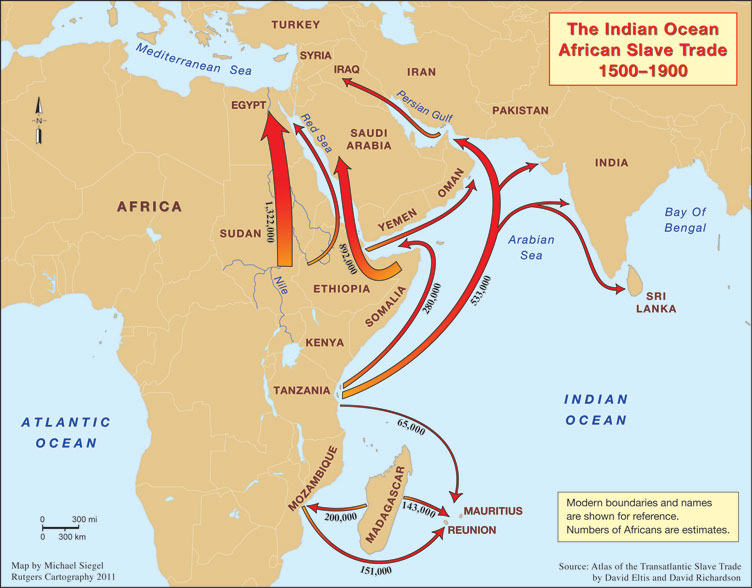
It is important to note, however, that not all slaves in Iran were African, and not all Africans came to Iran by way of slavery. Iran also had a large number of slaves from Southern Russia and the Caucuses in the north, while some African sailors came for work in the Persian Gulf. Despite this, the “black slave” image is dominant in Iran. By the nineteenth century, African slaves were prized as domestics or concubines in wealthy households.
Slavery persisted as a legal practice in Iran until 1929, when parliament introduced a bill that granted slaves freedom and declared them equal to all other Iranians. Although African slaves were dispersed across Iran, many Afro-Iranians settled in southern regions bordering the Persian Gulf after their emancipation. Since then, census records have not adequately reported the numbers of Afro-Iranians, and statistical information on these communities is largely unavailable.
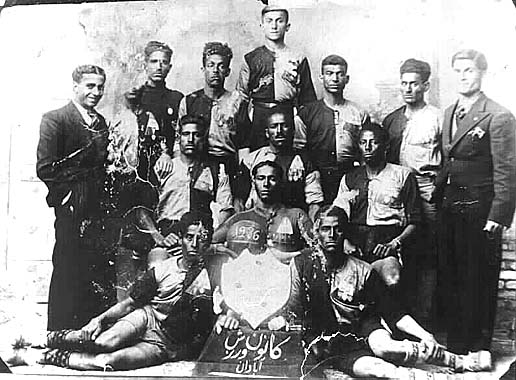
Depending on where they settled, however, Afro-Iranians have assimilated with varying degrees of success. For example, Afro-Iranian communities in the Sistan-Baluchestan province function separately from the rest of society and perpetuate a rigid caste system within their community that offers little opportunities for social mobility.
The highest social class in the community are the Durzadehs, Africans who came to Iran for maritime work. The name Durzadeh comes from “dor” meaning pearl, a nod to their occupations in the Persian Gulf. Because of their notable status, the Durzadehs regard themselves as higher than the Ghulams and Nukars, who came to Iran as slaves. The caste system is so rigid that the marriage between the Durzadehs and the Ghulams or Nukars is strictly forbidden. In Bandar Abbas, however, the Afro-Iranian communities have assimilated to a much larger degree, and interracial marriages are not uncommon.

Religiously, most Afro-Iranians identify with Shi’ism, a symbol of their assimilation into greater Iranian society, but folk traditions and mystic beliefs permeate their communities as well. In Behnaz Mirzai’s documentary Afro-Iranian Lives, she interviewed different members of the Afro-Iranian community in Qeshm, an island in the Persian Gulf, to better understand the practice of zar, a belief that people can be possessed by up to seventy-two different kinds of winds. The belief in zar can also be found amongst indigenous populations in Egypt, Sudan, and Ethiopia.
Related to zar is gowati, the belief that dancing has healing properties. Bandari music and dancing have its roots in gowati, which has been largely eclipsed by the shiny costumes and Los Angeles Iranian music industry.
Despite the popularity of bandari music, however, the depiction of Afro-Iranians in popular media is fairly scant. The most famous portrayal of an Afro-Iranian is Bahram Beizai’s 1989 film Bashu: the Little Stranger. The film follows the story of a boy who is orphaned by the Iran-Iraq war and escapes war-torn Khuzestan for safety.
Bashu finds himself in the entirely foreign Mazandaran province in Northern Iran, where his adoptive mother buys extra bars of soap to wash his skin clean from its darkness, children bully him for his complexion, and villagers call him a bad omen. Baizai addresses racism and ignorance directly, taboo topics in mainstream Iranian culture.
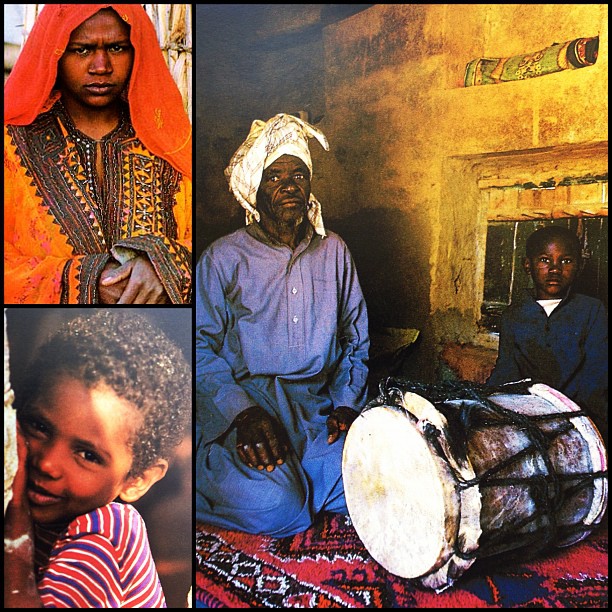
The neglect of Afro-Iranians by most Iranians stems from a number of factors, most of which stem from the Aryan myth. The Aryan myth effectively whitewashed Iran’s history, leading many to believe that true Iranians are only light-skinned and that Iran never engaged in slavery. Beyond this, the lack of Afro-Iranian presence in media further reinforces any preconceived notions that exist about Africans in Iran: that they simply do not exist.
Regardless of the reasons for the neglect, it is important to acknowledge the presence and history of the Afro-Iranian communities, not only for their sake, but with the intention of better confronting racist narratives, like the Aryan myth, that exclude so much of Iran’s population.
Standing in the middle of a crowd, the man in this video relates his experiences with lighter-skinned Iranians in Tehran pestering him questions about his blackness. Because many are unfamiliar with Afro-Iranians, especially in more northern areas of Iran like Tehran, many quickly assume that people with darker skin are foreigners. These assumptions lead to much confusion with the so-called “foreigner” begins speaking Persian. In this man’s experience, people in Tehran stupefied by his Persian approached him and asked,
“Excuse me, sir? Excuse me? But why are you Black? Why are you Black?”
Perhaps if, as Iranians, we educate ourselves, fewer Afro-Iranians will be perceived as foreigners or as “less Iranian” than the rest of us.
Sources:
Discover more from Ajam Media Collective
Subscribe to get the latest posts sent to your email.


88 comments
http://jadidonline.com/story/22052009/frnk/zaar_ritual
http://www.facebook.com/media/set/?set=a.2254527877109.2124691.1065676271&type=3
Book on Zar ritual and African presence and slavery in Iran
My god, in all my years of life I have not once heard of slavery in Iran. In fact I was ignorant enough to think it never happened her. I thought southerners in Iran naturally had darker skin. I have had history for 5 years from grade 4 to 9. How do we not know about slavery? Guess I have to deal and confront with this absolutely uncomfortable fact. The thing is we have so many problems in Iran, dealing with racism seemed far fetched and beside the point. Ive always viewed Iran the way you said i. all these 6 tribes equally persian.O cannot stress enough that how MAD i am because of this inexcusable brainwashing.
THANK YOU, AND A—H BLESS YOU FOR THIS MOST ENLIGHTENING INFORMATION. I TOOK TO VERY PERSONALLY SINCE I AM BLACK AND MY BIRTHDAY IS MARCH 20TH.
I mean no disrespect, but reading this is illuminating; I can see why Iranians here would be distant towards us black folks when they don’t even know about their own countrymen who are black!!
great article, do Black Iranians have an online social presence?
I am black Iranian except that this is because I am mixed with an African father and Iranian mother. I grew up in Tehran hence never saw Afro-Iranians, next trip to Iran will include the South and exclusively meeting the people I resemble. This article is wonderful, thank you SO SO SO much.
I am Nigerian but have Iranian relatives… I thankfully haven’t had any issues with race but have been warned they do exist and not to be shocked if it occurs. Would love to meet more African-Iranians both of mixed heritage and those from the south. (AA)
Thank you so much for this article. I’m Iranian and love reading about all the different ethnicities in Iran. Afro-Iranian culture and history is important , we need more education about this topic.
Thank you so much for this article… I am an African Persian, my father is from Abadan and Ive spend so many years since i was 14 trying to gather information about my African Persian history… I am 40 years old now and there is still very little information out there and it doesnt help that the country is constantly going through wars and sanctions. i came across this through one of my desperate searches online for keyword, African persian. it warmed my heart and made me so happy… thank you.
Peace and love to all beings….
It is quite nice! happy to see someone from the region here on this post.
Hi Zangi, please get in touch I would love to talk to you as I am writing my dissertation on Iranians with African heritage.
Hi Zangi,
I know that you wrote this comment many years ago but I am writing my Dissertation on Afro-Iranians and would love to have a chat with you if you have any free time at all. My email address is saneinina@gmail.com. Please email me on there if you see this.
Best Wishes,
Nina Sanei
Blackface is deemed racist in the context of the US experience with slavery. Since Iran has an entirely different social/historical context, blackface doesn’t mean the same thing there as it does here.
Hi Hassan, I would agree with you that slavery in Iran and the US were different, but I also disagree with you. Of course blackface in Iran and the US are not synonymous, but I believe that depicting Haji Firuz in blackface is a majorly influence by the East African slave trade in Iran during the 19th century. Blackface is not the only slave marker when it comes to Haji Firuz. Other markers include:
1) his title as “haji” –a derisive label given to many slaves in Southern Iran for being trafficked along the same routes between Arabia and Iran as Muslim pilgrims,
2) his name as “Firuz” –African male slaves were often named old Persian names (likewise, African female slaves were given the names of flowers),
3) his role as a minstrel and his famous rhyme, which I wrote and translated in the article.
Although individuals from East Africa were not the only ones brought to Iran as slaves–we know that the Caucasus were also an important source of slavery for Iran prior to the 19th century, the truth remains that slaves, such as Haji Firuz, are traditionally presented in blackface to further his “othering” in Iranian gatherings. This othering–and thus, dehumanization–is what I have deemed here as racist.
Explanations of the blackface as soot from the fire, etc, serve to only prevent a critical dialogue about the use of blackface in Iranian society.
Is this the only article you have written? I wish you’d write a book. Many of us would buy it… great info and great responses!
Haji is not the arabic word you are thinking it is written with the other “h”. I am not debating the history or slavery or the heritage of afro-iranians, however haji firouz predates all of this and has a different symbolism than what you think. Haji pirooz is not supposed to resemble a black person. It is a symbol of those who tended to the fire in the zoroastiran temples. Because of their job, their faces would be black with smoke and coal. And there is a reason why haji pirooz wears red, it is again related to the symbol of fire. So though i agree about the mistreatment and racism that the afro iranian community may face (and i hope it changes for the better) i don’t think its right to give a tradition that has different roots the explanation of slaver
Thank you for elucidating this misunderstanding that many Persians may have regarding “blackface”.
As in most instances regarding social prejudices, it is not so much the word as it is the intent and mind-set associated with the word.
ASA.WHEN DID SLAVERY END IN IRAN?
Thank you.
The point nowadays is not whether slavery as an institution has ended in Iran. The more urgent concern are the effects it has left on the hearts and minds of the oppressor and the oppressed.
In America, we have been learning over the past decades that the institution of slavery has left its ugly mark in the social attitudes of blacks and whites. That is our challenge here.
My hope is that Iranians of whatever color will begin to tackle the thornier issues of societal bigotry and biases.
Fare thee well, homie!
In my estimation, an acknowledgement and an embracing of divergent groups of people living in one’s country is the beginning stage of reaching a state of spiritual maturation.
All the Messengers of God have been patiently grooming humanity to attain this status.
In this new cycle of Religious Revelations, there are, relevant to the theme in mind, two quotes I’d like the readers to consider:
1) “O CHILDREN OF MEN! Know ye not why We created you all from the same dust? That no one should exalt himself over the other. Ponder at all times in your hearts how ye were created. Since We have created you all from one same substance it is incumbent on you to be even as one soul, to walk with the same feet, eat with the same mouth and dwell in the same land, that from your inmost being, by your deeds and actions, the signs of oneness and the essence of detachment may be made manifest. Such is My counsel to you, O concourse of light! Heed ye this counsel that ye may obtain the fruit of holiness from the tree of wondrous glory.”
(“The Hidden Words”, #68 from the Arabic Section)
2) “It is forbidden you to trade in slaves, be they men or women. It is not for him who is himself a servant to buy another of God’s servants, and this hath been prohibited in His Holy Tablet. Thus, by His mercy, hath the commandment been recorded by the Pen of justice. Let no man exalt himself above another; all are but bondslaves before the Lord, and all exemplify the truth that there is none other God but Him. (The Kitab-i Aqdas, p. 45)
Both quotes are from Baha’u’llah and were revealed in the 1850’s, in Baghdad, and Akka, respectively.
The “Seal of the Prophets” allowed for the institution of slavery to continue through His wisdom. But He never intended that the slaves be mistreated and to be set apart from the rest of society much as one would separate a leper(s) and banish the lepers to a place apart from the community.
Racial bigotry, ethnic bias, religious bigotry and fanaticism, are forms of “spiritual leprosy”. Better that the sufferers should cleanse themselves of such afflictions. Else, they should be restricted
by an enlightened societies laws and mandates against such behavior.
Much of this is hard for many of my fellow Americans to accept in their hearts and minds. In the meantime, maybe my Arab and Iranian brothers and sisters will be able to understand all these things and implement them so as to outshine the rest of the world.
Inshallah!
Oh dear dear dear, Haji Firooz is originally driven from Khajeh Pirooz. Totally another meaning and context than described here
Thank you for the article,
though I have some problems with it.
1- it seems to me that the writer is looking at this case from a western perspective without considering the context, history, mythology of the country.
2-the article is very selective in information, being the contextual referral and slavery of Africans in Iran.
3- perhaps it’s good to define what you are referring as Iran, modern Iran or Iran as a whole, culturally and geographically. maybe that can also the second point.
4- bear in mind slavery doesn’t happen through the colonial time but it goes back millenniums before. therefore lots of Africans in the region have been there perhaps longer than the country Iran existed, have a look at ashurian stone carvings and texts. it’s well documented.
5- I suggest having a look at the Mesopotamian mythology you will find lots of similarities.
BANDAR ABAS WAS POSITIVE EDUCATIONAL INFORMATION FOR MANY WHO ARE UNAWARE OF ITS EXISTENCE; BUT IT SEEMS TO ME THAT HAJI FIRUZ, IS A “CLOWN” AND THERE IS NO MENTION OF ANY OF THE IMAMS WIVES BEING BLACK, THAT WOULD APPEAR TO ME AS A MORE BALANCED REPRESENTATION OF NUBIAN PEOPLE.
Original Arabs are black. All the Imams were black. Their are books who describe Imam Ali as a very dark skinned person. But unfortunately in Iran, they have “Aryanized” him.
As Salaam A’laykom
While this article is interesting, I don’t find it factual. To say most of the Afro Iranians came from slavery is disingenuous and I would ask anyone to show definitive proof, which supports such claims. Yes, you can see these sorts of claims on even UNESCO webpages, but does it make it factual? I can say the sky is purple and be the president of the United States, but it would still be a untruth.
Now how do I sustain my claim that these people probably are the oldest populations in Iran? Well, what did eye witnesses say about the Persian population in earlier times? We know the people of Elam were called “ethiopians” which just meant someone who has burnt skin in Greek. It was the Greek term for “negro” in their time. THey also said the Persian army was at least 50% “ethiopian” according to Herodotus, who saw these people with his own eyes.
The blacks in India called Sidis are also not slaves. First, the word “sidi” means lord. Why would you call a slave a “lord”, it doesn’t make sense. Those people were part of the Axumite empire and they went there as rulers, not as slaves. There is a book written on it called “African Elites in India” by Kenneth X. Robbins. You can watch the video here http://www.youtube.com/watch?v=jJLGBvjqzlY&list=PLE45ED7A49A1CF636 <— While he does acknowledge that many came as conquerers, he slips into Eurocentric diatribe by claiming that some were slaves. I call such claims into question, as he makes the claim, yet shows no documentation that proves these people were slaves, other than him saying so. However, there is clear proof, documented that these people came as conquerers. Also if you read the book "Kebra Nagast" which is a book that chronicles the dynasties of the Axumite empire, it says their empire stretched to India.
So here we have black populations being in mesopotamia (Elam/modern day Iraq) and Persia (according to Herodotus' book The Histories, written in 500s B.C.) from antiquity, far earlier than the supposed importation of slaves in the 1500s A.D. If I remember right, Strabo (another historian) also said the Persian population was partly Ethiop (black) in his day (he was around 64 B.C.). Which means eurocentric claims that Africans only showed up in large numbers outside of Africa as slaves is moot! Africans are the first people on this planet earth and as such they would have wondered out and settled down. Where they had large concentrations and less interaction with outside peoples, the populations remained fairly dark, which is what you see in Iran today.
I totally agree with your post Tunka Manin. These articles, while educational, are also dangerous because they brainwash people to associate slavery with black people and to assume that black people outside of africa have to be descendants of slaves. African history in the Middle East is very ancient. Reducing that history to blacks being nothing but slaves, is not only insulting but very racist.
If anyone were to assume that all Blacks found in non-Black countries were descendents of slaves that would be ignorant indeed. But I think the purpose was to be educational.
What you say doesn’t negate the fact that there are deeply-felt prejudices that lighter-skinned hold dear and often equate dark skin with being a “descendant of an Abeed”. Reading abiut the plight of the Akhdam in Yemen, the dark skinned people of Mauritania, and in other Muslim societies, one often hears an insult hurled at a dark-skinned person as being “Abeed”. Indeed, to insult such a person, the lighter-skinned Muslims resort to hurling this epithet.
In Oman, it is often felt, especially in the other villages and wadis, that the mark of black skin is a sign that a person is an ancestor of a slave, and therefore is relegated of a lower status.
To ignore these nuances is to show an unwillingness to correct the peredominant perception of the worth of a person based on skin color. “Colorism” is a dysfunction that afflicts most societies in the world, including India, the Far East, Europe, and in the Americas, as well as Muslim societies.
Forging a community that transcends the mis-conceptions of skin color is the next great hurdle for humankind. Just speaking from the perspective of a Baha’i of African(and European) descent.
The majority of your comment has nothing to do with Afro-Iranians. That being said, the UNESCO data is based on research done by a post-doctoral fellow at Rutgers University. If you read his work, he recounts the writings of Khyzran an African fugitive slave from Iran in 1865. The buying/selling of African slaves in Iran is actually well documented if you wish to do the research.
True indeed!
But I think we should be careful when we talk about dark skinned Iranians or Middle Eastern people. Mr. Gem is actually right when it comes to the people of Elam, whom were a dark skinned semitic people and lived in southern Iran. And most dark skinned people in the south, are decedents of Elamite people. It wasn’t uncommon for Persians and Elamites to marry. Iranians in general are very mixed.
You present a very good perspective, worthy of a more wider field of view.
OMG good to hear we have brothers and sisters in iran am from the source of nile ganda (http://en.wikipedia.org/wiki/Ganda_people) come visit us bro/sister
As an African-American whose religion comes from Iran (Baha’i Faith), I found this article to be interesting and Iinformative. Virtually all of the Iranian (they prefer ‘Persian’) Bahai’s I have met in the U.S.A. can pass for ‘white’. I was stopped on the New Haven Green (CT) years ago by an Iranian. He gave me some inf. & we talked for awhile. He had medium to tight afro type hair and dark olive brown skin. I ‘knew’ he was an Iranian of ‘black’ or ‘African’ heritage, instinctly & obviously! About 15 yrs. ago, a book was published by the Baha’i publishing trust about the life of the ‘African’ descendant ‘servants’ that worked for Abdul-Baha (son of Baha’u’llah) and Baha’u’llah (Manifestation of God). It is called, ‘Black Pearls.’
I’m african american married to an iraninan man. He didn’t know about black iranians either. I’m not quite comfortable with the explanations I’ve heard on Haji Firuz and probably will never accept that there is no racism involved with this caricature. I would say that that mostly has to do with my experiences as a a black person living in the US. At any rate, I hope that blacks in Iran will enjoy all the rights of white iranians and that they should play a role in bringing positive political change to Iran.
Informative article, but Bandar Abbas is a native Sunni city. MOST NATIVE Bandaris are majority Sunni, those of Afro, Arab or Persian origin, all of them except the non-native from Tehran, Isfahan etc. who were moved to the south. http://www.sonsofsunnah.com
So you see Bashu in Beyzaii movie as an African-Iranian? I don’t think so. not every dark skin tone in Iran is considered black. In Isfahan we have many dark skin toned people like Bashu and we don’t see them as African. are you sure you are talking about the same movie?
I am Afro Iranian and grew up in Abadan, and moved to the US. Yes he is black. There are a lot of afro iranians who have a dark complexion that try to deny the fact that they are part black. People do it all the time. It’s nothing new. It’s everywhere, latino baseball player sammy sosa denys his black roots even though we all know he is at least part black.
In terms of the actor, no offense meant, but how else would the actor gotten that dark? He didn’t get a tan. I have a dark skin tone but my hair has a different texture to what people think the “average black girl” has. People think I’m mixed. But I always say I am a black Iranian. I have more black than iIranian in me obviously but overall I’m a black iranian. You shouldn’t view dark toned Iranian people as different and every dark tone in Iran more likely than not has at least some black. To say they have none is ridiculous. We are of African descent amongst Iranian descent. I hope people don’t continue to view afro iranians as separate from iranians simply because of that. People nowadays are starting to wake up and understand that being black is no different then being anything else. They are now starting to claim the black blood that runs in their veins. I’m sure there are many “Iranian looking” iranians with some black in them that don’t know or just don’t acknowledge it because they “look iranian”, which to most people range from light to medium tones with dark hair.
Hopefully we can spread the word about black Iranians. It gets a bit cumbersome explaining to people how I from Iran, am fluent in Farsi, but am black. I am black, but I am also Iranian. Why can’t the two go together?
The thing is, in the film Bashu was speaking a dialect of Arabic; the author of this article says he is Bandari but don’t the Khuzestanis speak Arabic?
All humans on earth are mixed. There is no pure race. Even some very blond, blue eyed people in Iceland could have Negro blood. You could look very Caucasian, but if you go back centuries back you’ll find a Negro or Mongoloid ancestor. I’ve seen many Scandinavians with Negroid or Mongoloid features, never mind in Italy or in Iran. Every Iranian, without exception, has Negroid, Mongoloid, Caucasian, Arab and Greek blood, that is to say the blood of all those people who surround the Iranian plateau. All Iranian are definitely darker than Europeans. I’ve not seen a single Iranian with the type of light skin color that’s found in Europe.
@EARTHLING
No not all people are mixed. Actually, black people have purest DNA and they are the first human beings that walked on planet earth. The Black race, is the oldest race. As for Iranians, they are mixed race people due it’s long history.
Avizeh:
Yes, if you read about the history of Southern Iran, you would know that the kingdom of Elam existed there. They were later integrated in the Persian empire. Persians and Elamite people would marry each other. And Elamites were a black semetic people, related to Tigrinya, Amhar, (Original) Arabs and Hebrews. Iranians have mixed with Elamites, Caucasians, Mongols/Turkic peoples and Dravidians. So yes, that can explain why Iranians look so different. Because their is no such thing as an “typical Iranian look”.
I think this article is totally misleading. Haji firuz goes back to pre-Islamic Iran’s history.I am not rejecting the slavery facts throughout middle east history. but haji firuz has nothing to with black people or any race. I invite you to read this article which more accurate.
en.wikipedia.org/wiki/Hajji_Firuz
Wikipedia is not an article nor a reliable source of information. I can go in there and update it with any type of garbage I want. Should it then be passed on as fact?
Very interesting article.. You should however mention that during the time of the Achaemenids we had many black citizens in Iran and their descendants would have stayed too. Also in regards to the tribes of Persepolis the three main Iranian tribes were Parsa, Medes & Elamites. There is strong evidence to suggest Elamites were actually black as depicted on the Apadana walls of Susa. The Aryan myth is not a myth we were Aryans but Europeans stole our identity Aryans do not have pale skin, blonde hair and blue eyes rather they had tanned skin, dark curly hair and various eye colours according to foreign accounts. Regardless of which great article thank you for sharing 🙂
Cecelia Duvall
Fair enough, a lot of what I said didn’t have to deal with Iran, so let us deal with Iran and its black population, shall we? One of the earliest civilizations to emerge from Iran around 3,000 BCE is the Elamite civilization. The father of Assyriology and the man who deciphered cuneiform ie Sir Henry Rawlinson, had the following to say about the Elamites:
“If it be true, as Dr. Lepsius has recently asserted, that the Beja, the most ancient dialect of the Ethiopic, be of the Caucasian family of languages, it will go far to connect the Ethiopians of Africa with the Eastern Kush. I have long, indeed, suspected, and am becoming daily more convinced that the languages of the so-called Median and Babylonian Inscriptions will be found to be nearly connected with those of Western Africa, and that the links of the connection will be traced in the migrations of the Kush.”
That is from page 114 in Memoir on Cuneiform Inscription by Sir Henry Creswicke Rawlinson. In case you are unfamiliar with African history, Kush was the empire that gave rise to Egypt. It was the south of Egypt and it was much older than Egypt and lasted a lot longer as well. Now, we have to remember that Mr. Rawlinson was a man of his time, and naturally suffered from Eurocentric ideologies. As such, he sought to Europeanize anything associated with the founding of civilization. Hence, Rawlinson’s assertion that Beja language may link to a Caucasian language family. However, we now know this is a non-starter.
Now you may be asking yourself “who are the Beja and what do they have to do with anything”. Well the beja are a people form north east Africa. Here is a video of them:
http://www.youtube.com/watch?v=E5gdZFOEhmc
Herodotus, Pausanias, Diodorus and Strabo all who lived to see the Persians at their height said that Susa ie one of the Elamite cities in Iran, was “a Memnonian city”. That is important to note because according to all these people, Memnon was an “Ethiopian king” in Greek mythology, and was most likely based on a actual Egyptian or Kushite king, though which one, no one is sure. Some think it may have been Amenhotep III you can read about that here on the PBS website http://www.pbs.org/wgbh/nova/egypt/explore/sansmemnon.html. Ethiopian in ancient Greek meant a person with burnt skin. It was the name applied to all black people. You can read further on this in the book “The History of Herodotus: A New English Version, Volume 2” by Rawlinson.
The Middle East most definitely had a “Ethiopian” population LONG before the current white and mixed groups of people migrated in and mixed with the local population. And also long before any Africans were introduced as slaves into the Middle East. If you read the writings of some of the ancient groups in question such as the Sumerians for example they seemed to equate themselves culturally with Africans. For example, according to Dr. Langdon in his peer reviewed article “Sumer Egypt Chronology” on page 144 he states:
“It is incredible that the Sumerian theologians and poets should have regarded Egypt and Ethiopia and their gods in the same way as they did the lands and gods of Sumer itself. These three lands were associated with Sumer from the prehistoric period, and were centres of the oldest Sumerian civilization.”
So here we have ancient writers and archeologist and modern historians attesting to the fact there were ancient black populations in the Middle East who existed there before any other groups moved in. I am willing to bet you most of the blacks in Southern Iran are probably from that ancient black stock, because I highly doubt they just all disappeared into thin air, after all these ancient writers attested to their existence.
One other thing I wanted to address. You said the article was for “education purposes” and that is fine and dandy when we are dealing with well-researched facts. But when you are dealing with unsubstantiated statements that are used to paint a entire population as something other than what they truly are, well that’s just misEDUCATION, any way you cut it.
I leave you with a quote from Kenton L Spark in his book “Ethnicity and Identity in Ancient Israel”
“Herodotus seems particularly aware of the world’s extremities, saying that “the distant parts of the world…have those things which we deem best and rarest,” in this case referring to the copious amount of gold found in the north of Europe. As in this northern extreme, so too the Indians, who dwell at the “sunrise of all the nations of Asia,” and the Ethiopians, who dwell toward the sunset, have gold in abundance. The Indians and Ethiopians lived in hot, desert regions and were “black-skinned.” Herodotus does not suggest a climatic reason for this (as does Hippocrates) but surmises that both the Indians’ and the Ethiopians’ genital seed was “not white like other men’s, but black like their skin.” Ethiopians, that is, black-skinned peoples, lived not only southwest of Asia but also to the extreme east of Asia, in a region that Herodotus identified as the seventeenth province of Persia. As Herodotus explains it, these Ethiopians differed form those of Africa only in “speech and hair,” with the former having straight hair and the latter being “wooly-haired”. The Asian Ethiopians apparently lived nearer to Indian than to Africa, since India lay in the twentieth province of Persia and African Ethiopia lay to the South of Egypt, the fifth province.”
Thank you for this article. Whitewashed history continues to be taught and passed on from generation to generation. I lived in Iran and had no idea black Iranians existed until my mother who refused to tolerate racist attitudes informed me. Until then all I knew was from school and being taught that we are the Aryan race and thinking of myself as superior to others.
I’m tired of hearing excuses and justifications for our racist attitudes, including the existence of Hajji Firouz in the name of Santa, fire, coal, joy and harmless symbolism. It’s racist and offensive. Why do we continue to insist on continuing traditions that are offensive to groups of people?
My half black son will be taught better and will be on the right side of history.
It gives me a new view on the story of the three magicians who came to visit Jesus as a baby. A possible Afro-Iranian (Caspar) as an astronomer. There are many neolithic stone-circels for the observation of the galaxy in Africa.
I’ve read a few of the comments and there are diverging opinions as to why there is the presence of Blacks in Persia(Iran), and other parts of the old Ottoman Empire.
As I see it, there are at least 2 reasons that stand out:
1) “Modern Humans” began a journey out of Africa about 50,000 years ago according to recent research by population geneticists.
This journey led these early “Africans” to populate all parts of the earth. As those of the human family
journeyed northward, skin color became lighter to facilitate production of Vitamin D by the skin’s absorption of sunlight. Those with adequate sources of vitamin D from food sources had less need to change color(observe the people near and above the Arctic Circle).
2) In more modern times(pre-Islamic era up to the 1800’s), slavery was a primary means of importation of East Africans to the Persian Gulf regions and the Indian Ocean basin. Many of their
descendants are seen in places such as Iran and
Iraq.
3) To a far lesser degree, Africans just got up and left their shores of their on volition and settled in the Persian Gulf regions, for whatever reason.
So there are several possible reasons for the presence of very dark-skinned people in Iran compared to the fairer-skinned varieties.
The mystery is what led to the genesis of the notion of the “Aryan Myth”, the strong attachment to the concept of “colorism”, and why lighter skin came to be deemed as a “God-given attribute” of superiority.
I believe that this attachment to light skin vs dark skin is a result of a misunderstanding of the statements in the Bible, the Qur’an, and earlier Books and Sayings, which may be simply metaphors intended to communicate a spiritual message.
Color is not a virtue; it is simply a phenomenon.
This is all from my Baha’i perspective, and viewpoint
based on being an African-American born and raised in Mississippi in the 60’s.
i know it’s been a while since this post was published, but i just stumbled upon it, and more than the post itself (which is itself quite interesting) i have become more interested in the conversation it provoked. my own reaction is curiosity about the defensiveness on behalf of some commenters in response to the author’s proposition that many darker skinned-inhabitants in Southern Iran may indeed be descendants of the Indian ocean slave trade. This defensiveness (and implied shame) about the reality of Iranian slavery seems to imply, for example, that African-Americans, most of whom are definitely descendants of slavery, ought to be ashamed of a historical reality which they were in no way responsible for. Whether or not the proposition that dark-skinned Iranians living in modern-day Iran were slaves or part of much more ancient (and therefore more noble?) populations, we should be encouraging scholarship on the slave trade in Iran, not complaining that it distorts history. In fact, the very assertion that the legacy of slavery is irrelevant to the understanding of iranian cultural forms (like, haji firuz, for example) seems less a vie for historical accuracy and more a denial that cultural forms and symbols are not stagnant but evolve in processes deeply shaped by the ongoing changes and ruptures in societal power structures. Haji firuz may have his roots in a history which pre-dates slavery, but that doesn’t mean those roots are immutable or incapable of acquiring new symbolic meanings commensurate with new historical forms.
Although the link of haji firuz and a black population in the role of “servants”might exist in a not so long historical past, it is actually the topic on the knowledge of agricultural-seasonality and the knowledge of the sky that might re-veil the very strong contact between Iran and Africa. Considering the enormous architectural efforts both in Europe and Africa on megaliths as astronomical observatories (just before bronze age) and their co-appearance with agriculture, it is clear the population is dedicated to arrange live according to plant/harvest season and knowledge of astronomy. The role of Africa (outside Egypt)and it’s astronomical observations are far less known than for example Stonehenge or Newrange.
A side-link of studying African /Iranian/European astronomical knowledge in Neolithicum and Bronze-Age might be used to develop a hypothesis on a black population in Iran till this day or the role of the 3 kings/astronomers in the evangelie on Jezus birth. However these remain side effects. The topic of Astronomical knowledge in the earlier period of agriculture interest me. DNA analysis can reveil a lot more on the present populations in Iran than speculation.If slavery as part of iranian history is of interest, the DNA analysis could be used to date the period of influx from Africa. pre- or post Alexander the Great.
Personally, the topic started for me encountering grinding stones for grain to produce flower/bread in the Sahel. the present African population who lives there now uses the wooden mortar/pestels. Grinding stones lay strayed around on the tiger bush plateau around small melting furnaces for iron (early iron age ). Flint tools are all around.
Very well put. I find the shape and form humanity has taken, from those Modern Humans who began
a “Journey” to populate the rest of the African continent, and into the Levant, the Arabian Peninsula, and every other corner of the globe to be fascinating and enlightening.
What Religion has been saying all along in regards to our universal kinship has been, for the most part, beyond the understanding and capacity of the peoples of the world.
As a result, various groups of those original trekkers some 50000 years ago have branched off into certain geographical niches, such as what is now called Iran, and have fashioned separate mythologies and evolution stories about who they are and where they came from. From there these stories evolved to incorrectly infer a superiority of one group over other nearby groups—i.e., the Aryan Myth; the myth of the shade of skin coloring bestowing greater nobility over those of darker skin color; the fallacy of caste distinctions; etc, etc.
That so many Iranians are still infatuated with the notion of the Aryan Myth, and that one’s skin color is a measure of virtue and higher social and spiritual worth, is a sign of succumbing to superstition and “fairy tales”.
Fortunately, science has pretty much evolved from the status of quasi-science when it comes to the the question of the man-made construct called “Race”, and based on sound principles and recent molecular biological research and population genetics techniques, has finally joined Religion to the point that both Science and Religion affirm the Oneness of Humanity in a complementary fashion.
As science now confirms, we are all “Africans under the skin”. And Religion extends this to a level transcending the physical aspect—namely that we are first and foremost Humans who display an amazing array of outer aspects while maintaining a
a spiritual bond that inextricably connects us all.
However, up to now humanity as a whole, in Arabia, Iran, America, China, Russia, Israel, and elsewhere, are kicking and screaming in denying these assertions. Much as adolescents don’t like to take on responsibilities as adults once they reach that stage.
Such an over-all, world-embracing view, is the result of seeing through the lens of Islam, Christianity, the other older Religious Systems, and most recently, The Baha’i Faith.
Just my views as an ignorant African-American, born and raised in Jackson, Mississippi. I’ve seen up close a good deal of racial bigotry which has been born out of a desire of the majority race in America to continually assert its superiority over darker-skinned people. And I’ve learned over the past 40 years how wide-spread the disease is—even afflicting the Far East, the Middle East, and other regions of the Earth.
The behaviour of showing disrespect, disdain, and expressing a haughty air of superiority towards other is simply the sign of souls trapped in a darkness and a “deep sleep”.
“The earth is but One country, and humankind its citizens.” (—Baha’u’llah)
“seems to imply, for example, that African-Americans, most of whom are definitely descendants of slavery, ought to be ashamed of a historical reality which they were in no way responsible for.”
the point is not to imply that Afro-Iranians who are descendants of enslaved people should be ashamed of that fact. it’s true that Iranian society has anti-black racism aswell and I agree with you that many are not willing to discuss it. it is true that the reality of slavery is objectively brutal and inhumane, despite the differences between american and iranian slavery. with that being said, there are two major issues with the way this article (and beeta’s work in general) advance that claim.
first of all, beeta herself admits that the history of slavery in iran includes caucasian and iranian non-black slaves. given this, we have to ask ourselves how anti-blackness was introduced into the picture? furthermore, in a country as ethnically heterogeneous as iran, what could have led to the idea of “white supremacy” in general (including, for example, anti-arab racism, which is prevalent among the iranian diaspora and upper classes)
the answer is really quite simple if you look at world history. white supremacy was an ideology that was born out of centuries of european colonialism, devised after the fact to justify the colonization/enslavement of colonized populations, particularly enslaved africans who formed the bulk of the trans atlantic slave trade. this is the same european colonialism that turned iran into a semi-colony for years; the same power dynamic by which england monopolized iran’s oil for the better part of a century. it is also the same european colonialism that propped up puppet rulers like reza shah and his son, the former of which is responsible for creating the “aryan complex” that iran still has to this day (inherited from the white supremacist ideology of germany particularly, and other european nations in general, as well as inspired by the similar path taken by turkey’s ataturk)
it is via european colonialism that the ideology of white supremacy was disseminated in iran and elsewhere. beeta and you are getting close to this fact by asserting that while the historical roots of traditions such as haji firuz are not clear, it remains the case that the way they operate in a modern sense is to perpetuate anti-black racism. this is true! but locating the roots of that anti-black racism in admittedly multi-ethnic slavery is only a partial picture. it does not make sense until you connect the analysis to european colonialism and the ideology of white supremacy. that does not mean there was no enslavement of africans by iranians. there was! that does not mean that enslavement did not come to be combined with white supremacist ideology. it did! but WHEN and WHY it did is crucial, it was not simply the internal development of iranian society that led to this.
second of all, the issue of the black populations of iran. it is true that there are a significant proportion of black folk in iran who are the descendants of slaves. this is not a fact they should be ashamed of, nor is the anti-black racism that definitely exists in iranian society in any way excusable. that said, there ARE black people in iran who are not the descendants of slaves and the point some others have tried to outline here is that what IS RACIST is to assume that an iranian who is black is the descendant of a slave SIMPLY BECAUSE THEY ARE BLACK.
much of the writing on this subject by ajam collective and beeta reeks of racist paternalism, especially coming from Westerners. they claim that black folks in Iran who do not claim African ancestry MUST simply be ashamed and denying reality. in doing this, they cement the very binary they claim to be avoiding, the dichotomy between being Black and Iranian. according to them, to be black in Iran IS to be the descendant of slaves. is this not the very racist attitude in Iranian society that we are trying to get rid of? it is one thing to say that to be black in Iran is often to be TREATED like a slave or the descendant of a slave. it is one thing to say that Iranians often ASSUME that black Iranians must be the descendant of slaves. but to then turn around and claim that this racist assumption is necessarily true to the extent that we can identify Iranians as the descendants of slaves MERELY because they are black is ridiculous.
I’m from north of iran but i have some africain root in my body. Some people who met africains or live in Africa say that i have aficain body..etc Even people in iran ask me if I’m arab or i ‘m mixed ..etc.We are all mixed!!!
Thanks for this informative and insightful piece, I have always felt a bit uncomfortable about Haji Firouz and wanted to know more about the history.
Great article!!
Hello dear brothers and sisters. As an Iranian American I strongly believe that we need to spread the knowledge about African- Iranians. I personally never knew there was slavery during the Qajar period in Iran and I am shocked and absolutely disgusted by what happened. We are all Iranians and we are all family. I hope to visit southern Iran when I go to Iran this summer and I will share this with my family and my uncle who is a professor at Kerman University. Love you all.
Informative and controversial article. I enjoyed a lot by reading the very own of article and also comments. Great Job!
Wow! Thank you!
For those searching for a community dedicated to Afro-Iranians, I don’t think you’ll find such a thing. I live in Bandar Abbas and as mentioned in the article, There’s no sepration. My friends’ families are half dark-skinned half bright- skinned.
It’s nice to see someone touches upon a part of society that has been overlooked. Persians were pagans and parts of those beliefs (e.g. Ahura Mazda) carried over into Zoroastrianism which developed most of what we see today in terms of Persian New Year. The soot on haji firooz’s face is symbolic of the fire – chahr shambeh soori is one way fire is still relevant in the culture. This all predates slavery. This still doesn’t undermine the fact that racism is prevalent in the current society. It’s not just limited to skin color but different races and religions as well. It’s also not just in Iran but in other countries too. It definitely needs to be brought to light but with fact and not fiction.