


A guest post by Ramina Samuel, co-founder of BET KANU Inc., a non-profit focused on Assyrian language preservation, and an advocate serving Assyrian families in the Chicago greater area. She is the founder of AssyrianFlag.org.
***
In March 2026, Iraq’s soccer team beat Bolivia 2-1 to qualify for the World Cup for the first time since 1986. I watched the game on a phone screen at an airport far from the pitch, but I savored the rare sense of collective joy among Iraqis I saw onscreen. As the Iraqi players celebrated, they raised not only the official Iraqi standard but also a blue-white-and-red flag that I know well: the Assyrian flag.
Held aloft by the team’s five members of Assyrian heritage, the flag’s appearance was an unexpected moment of visibility for Assyrians that sparked pride among the global diaspora and curiosity among many non-Assyrians.

My first memory of the Assyrian flag was in Nuhadra (Dohuk) a small city in northern Iraq encircled by mountains. I was a child walking alongside my activist parents at a parade celebrating the Assyrian New Year, known as Kha B’Nissan or Akitu in Assyrian. Seeing the flag and being surrounded by members of my community dressed in traditional clothes and shouting “Khaya Atour” (Long Live Assyria) filled me with an overwhelming sense of unity.
I was too young then to ponder how a flag came into existence. Yet my little fists formed part of a continuous history.

In Assyrian neighborhoods and villages in Iraq today, it is common to see the Assyrian flag at celebrations. But Assyrians only started to openly celebrate their new year after the establishment of a safe haven in northern Iraq in the early 1990s. Public celebrations were the result of the efforts of generations of Assyrian activists who paved the way for greater recognition of the community’s rights on their native lands.
Fewer than 300,000 Assyrians live today in Iraq, down from 1.5 million before the US invasion. Hundreds of thousands more live spread across Iran, Syria, Turkiye, Lebanon, and Palestine, and around 3 million Assyrians live in diaspora. They are united by a shared language, history, and culture.
In 1992, I moved with my parents from Baghdad to the northern region, reuniting with one side of the family while losing sight of the other. My mother’s native village, Bakhetme, was destroyed in 1987 during a campaign of collective punishment by Saddam Hussein’s government against Assyrian and Kurdish communities across the north. As a result, we lived in Mesurike, an encampment town built to host the displaced people of my mother’s village.
I developed a deep pride in my Assyrian identity while living in Mesurike. I learned that the Assyrian flag hanging around the village represented our people as a whole, rather than a single political ideology or party. The flag was an embodiment of community resilience in the face of oppression, and a beacon of unity for Assyrians across their indigenous lands and in the diaspora.

In 2004, a year after the US invasion, my father was injured in an attack as violence engulfed Iraq. I emigrated with my family to Chicago, joining an estimated 80,000 Assyrians there.
About three years ago, I was ordering flag banners for the Assyrian Club at the school where I work as a counselor. I quickly realized that the Assyrian flag was not an accessible product online. I also found at least five different versions of what is supposed to be the same flag. Once I started looking closely, I even found different versions of the flag within my own house. The symbols were printed in different colors, ranging from red, black, brown, and gold. In some cases, they were completely absent.
I realized that, as a people, we are losing track of the correct version, or even where the flag had come from. I began to wonder: what is the history of the Assyrian flag? Why are there so many different versions? And which is the official one?
As a people without a state, it was hard to find answers to these questions. There were no national archives I could visit, or official history textbooks to consult. Assyrians live spread across many countries. Our history, too, is scattered around the globe.
I began searching for answers. Members of the Assyrian Universal Alliance (AUA), the organization that had originally called for a unifying flag in the sixties, heard about my research into the flag’s various designs. They started supporting my efforts to trace this history and create a site dedicated to the evolution of the Assyrian flag.
In this article, I present the history of the Assyrian flag and how it became a unifying symbol in Assyrian communities worldwide.
The First Assyrian Flag
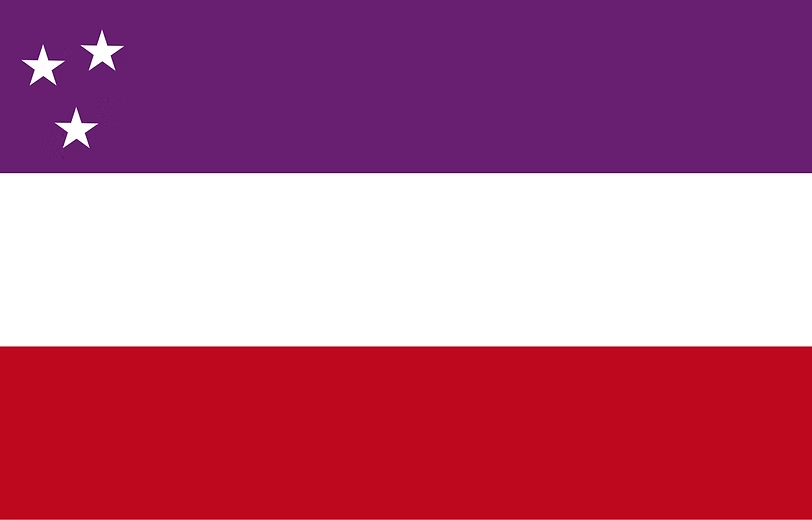
The first Assyrian flag was created by the Syriac Orthodox community of Tur Abdin in Turkiye before World War I. It had three horizontal stripes and three stars. The three stars represented the three main denominations of the Assyrian community at the time: Syriac Orthodox, Church of the East, and the Chaldean Catholic Church.
In my research, I found several versions of the WWI-era flag, varying in design, colors and elements. It has three stripes and three stars, another has an added seal featuring an archer shooting an arrow on top of a bull. Sometimes the colors are purple, white, and red; others describe them as salmon, white, and red.
In 1916, the version of the flag containing a seal was created by Reverend Joel E. Werda, President of the Assyrian National Association of America, and Executive Secretary Charles S. Dartley.

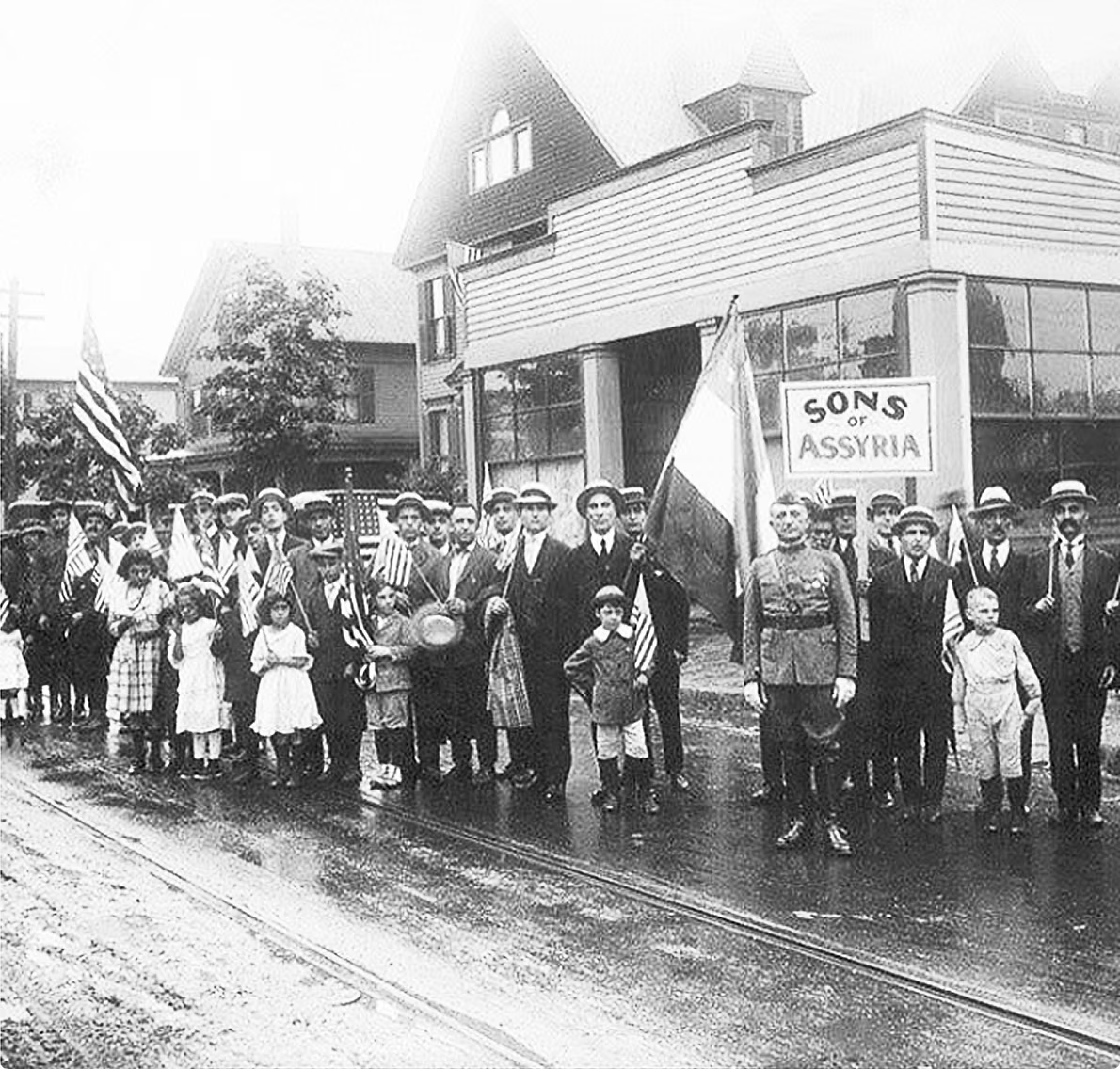
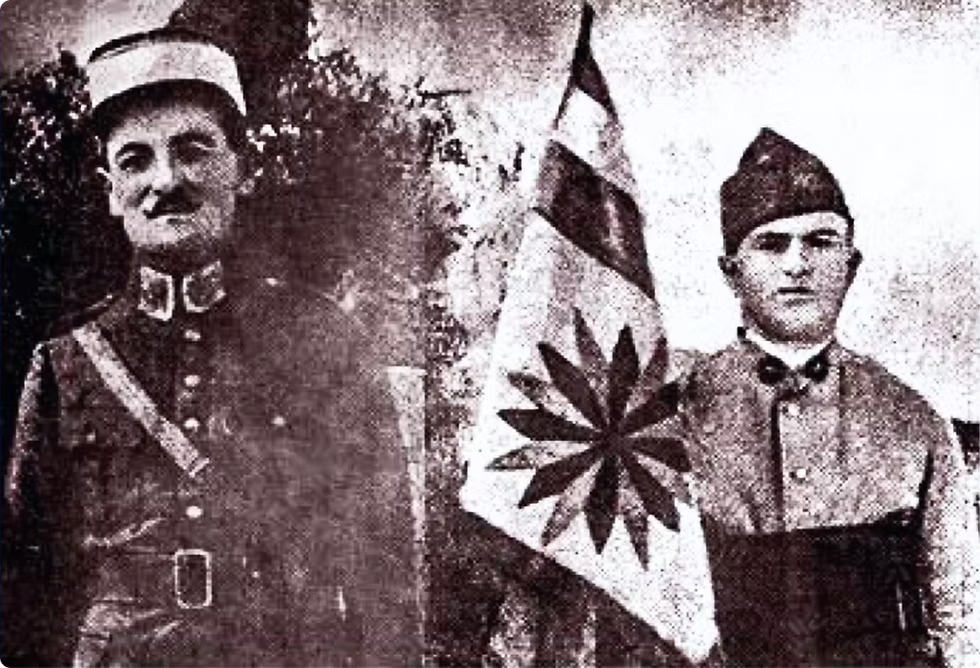
Assyrian military leaders Agha Petrus and Malek Kambar’s flags are among other standards that came out during WWI to represent different Assyrian movements.
Agha Petrus led Assyrian volunteer forces and later took part in efforts with the British to advocate for Assyrian autonomy. Malek Kambar was associated with French-backed discussions of possible Assyrian autonomy in the Jazira region, though no lasting political entity was established.
But after World War I, the Assyrian homeland was divided between different countries and the earlier Assyrian flags became less widely used. Until 1968.
On April 13th, 1968, Assyrian Universal Alliance (AUA) was founded as a worldwide political organization aiming to secure the human rights of the Assyrian people in their homeland and attain an autonomous state in the Assyrian ancestral homeland. With chapters on all major continents, AUA has been a member of the Unrepresented Nations and Peoples Organization (UNPO) since 1991. It has been a driving force of Assyrian activism worldwide since its founding.
Soon after AUA’s inception, the organization addressed the need for the Assyrian nation to have its own official national flag. They appealed to Assyrian artists and experts worldwide to collect ideas in a design competition. Eventually a decision was reached in favor of a design described by the late Homer Ashurian, AUA’s former History & Cultural Director, as the one that best captured the Assyrian essence.

Ancient Symbols for a Modern Nation
This design belonged to George Bet Atanous, an Assyrian living in Iran. Bet Atanous was an Assyrian history and art enthusiast, described by some as a self-taught Assyriologist. His family moved to Russia before WWI, where Bet Atanous was born in 1919. But he returned with his family in 1927 to Urmia, the region they were from in northwestern Iran.
Urmia was historically home to a large community of Assyrians, with hundreds of villages dotting the hills and river valleys west and north of the vast Lake Urmia. Ottoman forces invaded Iran and killed many Assyrians in World War I, reducing their population from tens of thousands to several thousands and sending many more fleeing. But in the 1920s, Iran invited Assyrians to return and rebuild their communities. The region is considered a cradle of Assyrian culture, and Bet Atanous grew up in its heart. Urmia became a center of the modern Assyrian cultural renaissance.
While the flag was new, the inspirations that Bet Atanous drew on were anything but. The symbols are ancient Assyrian imagery dating back to the Early Dynastic Period of Sumerian art, including the ancient sun god, Shamash, the national god of Assyria, Ashur, to the Assyrian Imperial Standard.


These ancient symbols reappeared within the Assyrian community as early as the 1950s, when Assyrian intellectuals began to use the Shamash icon as a symbol of identity.

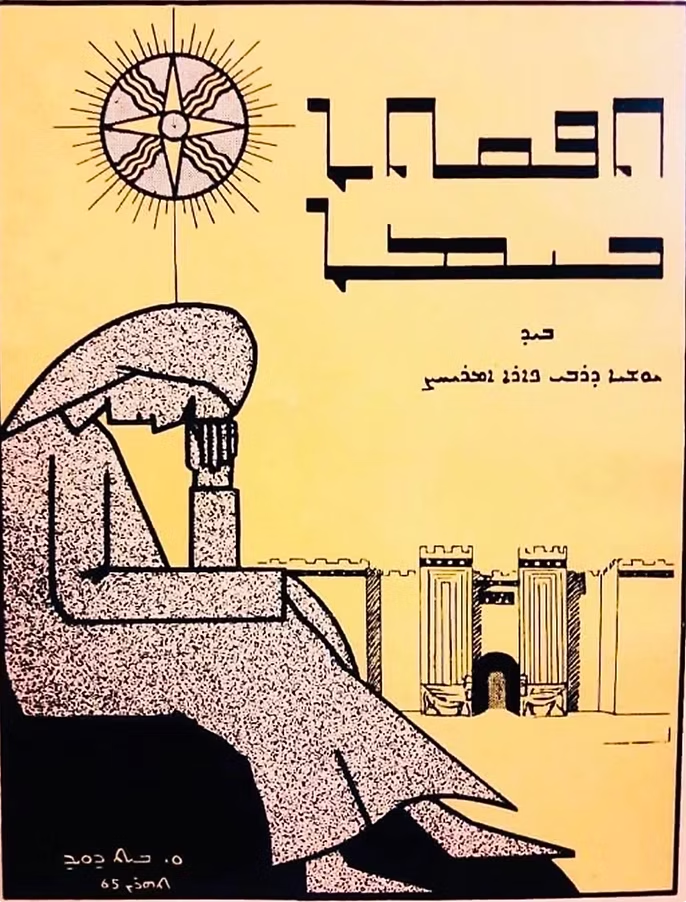
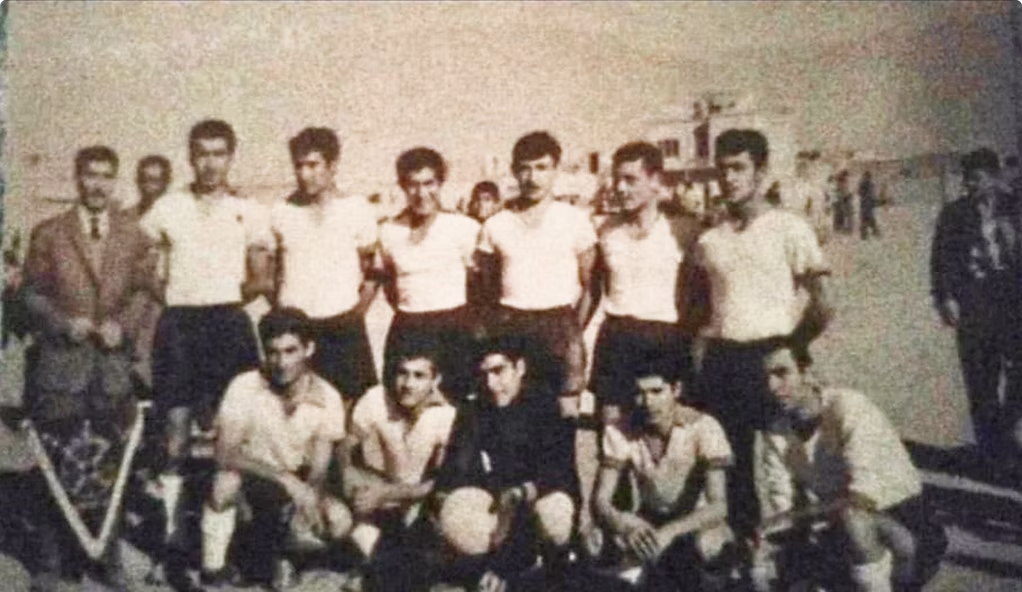
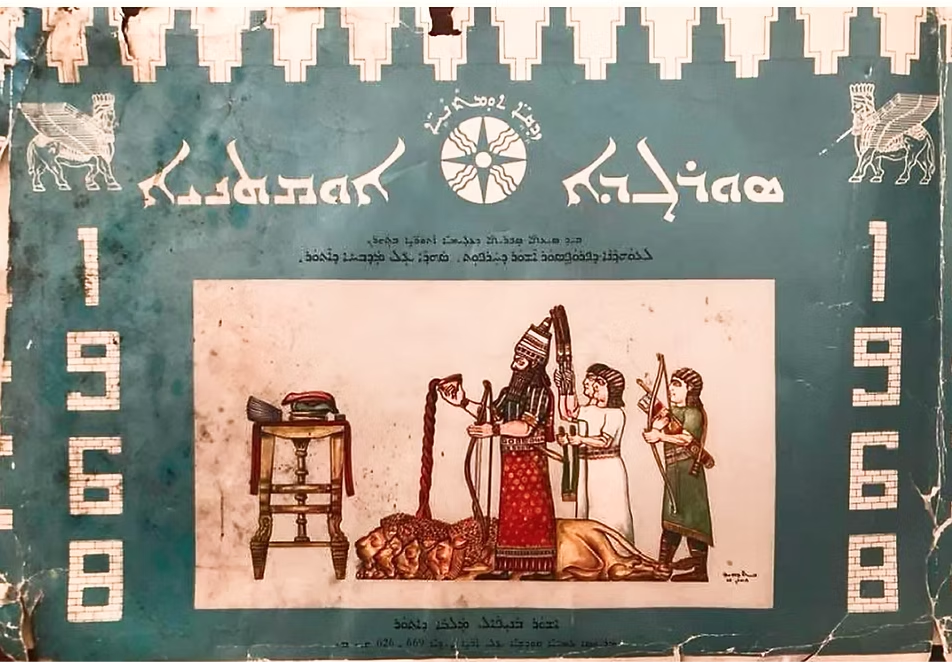
The golden circle at the center represents the sun, which, by its exploding and leaping flames, generates heat and light to sustain the earth and all its living things. The four-pointed star surrounding the sun symbolizes the land, its sky blue color symbolizing tranquility. The blue wavy stripes extending from the center to the four corners of the flag represent the Euphrates river. Euphrates is colored blue to symbolize plentitude. Euphrates in Akkadian is Prat, which means plentitude. This river was surrounded by agricultural fields that it irrigated and sustained the people.
The red wavy stripes extending from the center to the four corners of the flag, whose blood-red hue stands for courage, glory, and pride, represent the Tigris. Tigris is colored red to symbolize pride. The Akkadian name of Tigris is Diglat or Tigla meaning date palm. Palm trees grew along the banks of this river in thick rows, which probably inspired the name of the river.
The white lines in between the two great rivers symbolize the Great Zab river; its white color stands for tranquility and peace.

Bet Atanous’s flag design was approved by the 6th Congress of the AUA in Yonkers, New York in 1973. The flag has since become a common feature in Assyrian communities worldwide, both in the homeland and diaspora.
Assyrians have survived genocide, dictatorships, forced assimilation, internal conflicts, and displacement. But the Assyrian flag serves as a living symbol of resistance, standing against attempts at erasure and supporting the continuity of our people.
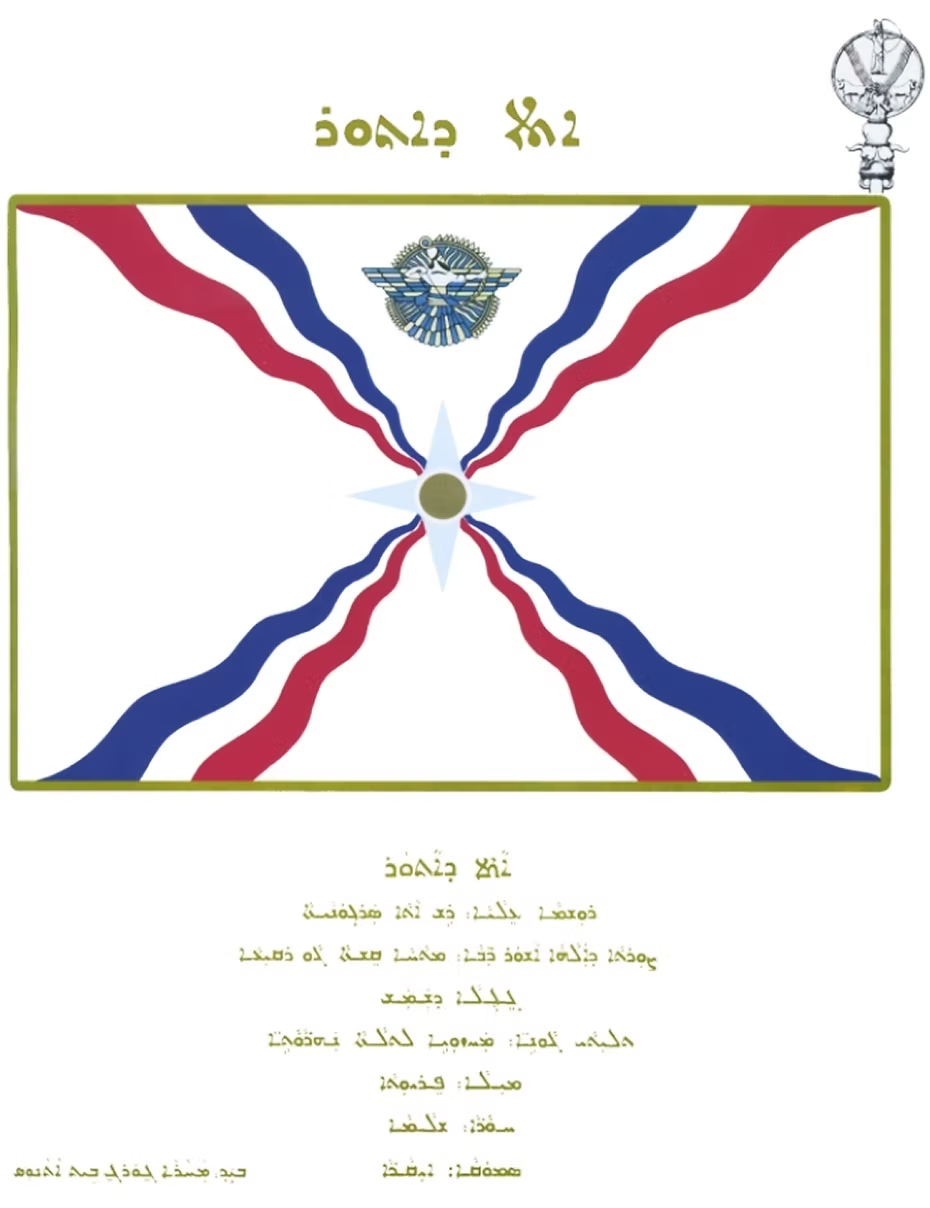
But because Assyrians are a stateless community, they lack the institutions to promote their symbols. This is why so many versions of the flag proliferated, using different symbols and images. But this is also why I believe it is so important to preserve the original Assyrian flag and to remember how it came to be.
Remembering the memory of the Assyrian activists and artists who made the flag possible is part of keeping our community alive.
As I researched this history, I was joined by Assyrians from Russia to California who offered expertise ranging from graphic design to archival collection to create a vessel of information accessible to our people and the world. It is now available at www.assyrianflag.org.
A flag is more than just a design. It is a symbol of unity and resilience that carries the memory of our ancestors.
I am proud of the Assyrian flag that hangs today in my office in Chicago. And I am happy to know that the same Assyrian flag decorates the streets of Assyrian villages across Iraq. I imagine girls just like myself waving our flag as they march in the Assyrian New Year parade, full of joy and surrounded by our community in their ancestral homeland.
My journey to understand the history of the Assyrian flag began with a question and ended with a collective effort that brought together Assyrians from across borders and generations. Time and lack of governing bodies may blur the information, but it cannot stand in the way of our determination to remember our history.

Discover more from Ajam Media Collective
Subscribe to get the latest posts sent to your email.


