


This article is part of the Unexpected Persianate series exploring overlooked, hidden and unconventional echoes of Persian culture, language, and aesthetics in the present. It is published in collaboration with the Association for the Study of Persianate Societies.
It is written by Larkin Cleland, a Hungarian-American journalist and geographer. In 2025, he completed a Fulbright scholarship at the Hungarian Geographical Institute. He currently uses his fluency in Persian and Arabic as a researcher for Global Energy Monitor.
***
The winter chill hangs over Košice, the capital of Slovakia’s easternmost district. The city feels tired and grey. I see the sign for a small restaurant above a hair salon and make my way upstairs in search of warmth and food. The waitress speaks only Slovak, but when I ask, “Magyar?” to see if anyone speaks Hungarian, she gestures for me to wait. Soon she returns with the cook, who describes the special of the day: tarhonya with chicken. It’s a classic Hungarian home dish, couscous-like balls of dried flour and egg dough fried in butter, then boiled.
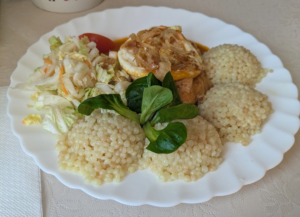
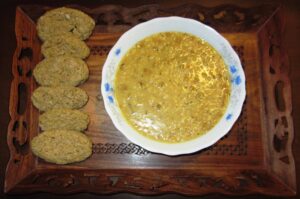
“There is no Hungarian food more Hungarian than tarhonya,” is how one lifestyle magazine describes the dish. This was exactly the type of authentic cultural experience I had set out to have as I learned the language and explored my ancestry in this historically Hungarian part of Slovakia. But when I finished my meal, I googled tarhonya, and found a result more complicated than I expected. The roots of the dish and the origin of its name are Persian, related to the tarkhineh (ترخینه) eaten in Iran today.
The cook behind the tarhonya was likely not thinking about the dish’s origins as she told me she had lived her whole life in now mostly Slovak-speaking Košice. Her ability to speak Hungarian, like her recipe, came from a grandmother who lived here before the Kingdom of Hungary lost these lands in the 1920 Treaty of Trianon. She told me she was proud to be Hungarian and proud also to see me, a descendant of a Hungarian great-grandfather who went to America, learning the language.
In 2010, newly-elected Hungarian prime minister Viktor Orbán and his conservative coalition passed a law granting fast-track (European Union) citizenship to anyone who can prove ancestry in “Greater Hungary” and who speaks the language. This represents a significant material and symbolic benefit for “Hungarians beyond the borders,” as Orbán calls us. Hundreds of thousands, the vast majority in Slovakia, Romania, Serbia, and Ukraine, have taken advantage of the opportunity. In the 2022 election, 94% voted for Orbán.
This strain of Hungarian nationalism draws a firm line between insiders and outsiders. Orbán’s right-wing party mainstreamed anti-Muslim xenophobia. The prime minister stood proudly as the only “openly anti-immigration” leader in the European Union, warning Hungary might otherwise become a “mixed race society” and conflating migrants with Islamic terrorists. He juxtaposed these “invaders” with the timeless cross-border Hungarian nation he claims to represent.
Orbán’s use of enduring symbols and myths of Hungarian identity, alongside his claim to represent the transnational community, were key to his brand of illiberal nationalism and his construction of a political dynasty. That nationalism is characterized by its ability to incorporate not just a single origin story and shared blood, but also ideas of a unique Hungarian mindset and affinity for the complex language, letting it include people with tenuous genealogical ties to the nation like myself.
While Orbán was defeated this April, the Hungarian nationalism he shaped seems likely to live on. The new prime minister, Péter Magyar, is a former member of Orbán’s party. He too has taken a hardline stance on immigration. And, one of the key stunts of his campaign was a walk from Budapest to Nagyvárad (Oradea), a major city for “Hungarians beyond the borders” in Romania—an appeal to transnational Hungarian nationalism highly reminiscent of Orbán.
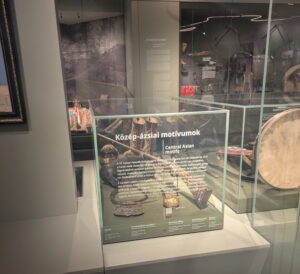
In the mythologized story of the Hungarian people that nationalists promote, the Magyars came from Central Asia across the Ural mountains and settled in the Carpathian Basin in the 800s C.E. A millennium later, explorers and linguists set out towards the Central Asian steppe to find the tribal groups who still speak Finno-Ugric languages distantly related to modern Hungarian. Even as the ruling party kept up its rhetoric against immigrants from the East, it recently spent 80 million euros to build a gleaming new Museum of Ethnography in Budapest, which prominently displays the Central Asian artifacts those explorers brought back.
The Persian roots of tarhonya, the quintessential Hungarian dish I tried in Slovakia, highlight the contradiction inherent to this version of nationalism. The dish did not cross the Ural mountains into Europe with the early Hungarian tribes. Rather, it arrived in the 16th century with the Ottoman invasion. From the Persian تر (meaning “wet”) and خوان (meaning “dish” or “food”), versions of tarhonya are now found across the region.
Iranian recipes for tarkhineh use bulgur and kashk while Anatolian versions use a fermented wheat dough with yogurt, but all, including the typical Hungarian preparation, involve a dried dough rehydrated as a soup or stew corresponding to the original Persian name. Folk etymologies even link this rehydration process to the demands of the nomadic lifestyle Hungarians lived in Central Asia, though the word arrived long after they settled down.
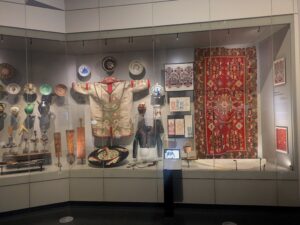
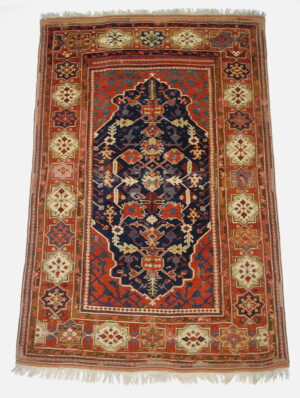
Tarhonya reveals a Hungarian language and culture full of influences from the East, including many of the most prominent symbols of Hungarian identity. The iconic Hungarian paprika did not exist before the Ottomans brought spicy peppers recently introduced to the Mediterranean from the New World, nor did the classic Hungarian stuffed cabbage. Tourists and locals alike still flock to thermal baths, both those constructed by the Ottomans, like Rudas Thermal Bath, and newer alternatives built after the tradition was assimilated into Hungarian life. One of the most striking examples of cultural mixing is traditional embroidery, also displayed at the Museum of Ethnography as a timeless Hungarian art, though many of its designs descend directly from Persian carpetmaking.
From a linguistic standpoint, there are at least several dozen New Persian loanwords by way of Ottoman Turkish, words like padlizsán (“eggplant,” cognate with Persian بادنجان), papucs (“slipper,” from Persian پاپوش), and csárda (“tavern,” from چارطاق or چهارطاق meaning “four pillars”). But there are also many more with origins in Middle or Old Persian that were borrowed directly into predecessors of Hungarian. Examples include tej (“milk” in Hungarian and cognate with Persian دایه meaning “wet nurse”), hús (“meat,” cognate with گوشت), and hét (“seven,” cognate with هفت).
Persian speakers are familiar with myths of a “pure” language and condemnation of contamination by foreign words. Movements to remove Arabic influences from Persian have been used to promote visions of Iranian nationalism that erase layers of identity and the unique beauty and history of Persian and its interaction with other languages and cultures. Like Hungarian interest in preserving language communities abroad, these movements have found particular footing in diaspora communities. But while educated Persian speakers usually recognize Arabic words, and educated Hungarians are often aware of the Germanic, Slavic, Latin, and even Indic (by way of the Roma languages) influences in their language, Iranic and Turkic words are less recognizable.
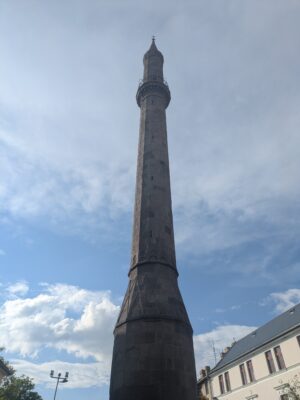
Still, the presence of these words evidences not just incidental contact between Hungarian and the Persianate world, but centuries of cultural and ethnic mixing, on the steppes of Central Asia in the 7th century as in the Carpathian Basin under Ottoman rule from 1526 to 1699. Hungarian nationalists mostly agree on the strict divide between welcome “Hungarians beyond the borders” and unwelcome “migrants” today, and they also agree on the ancient origin of Hungarians in Central Asia. But if we consider the 16th century, when invaders also brought so much of what it today means to be Hungarian, that line blurs.
Nearly all Hungarian schoolchildren read Eclipse of the Crescent Moon, by Géza Gárdonyi, a late 19th-century novel about the fight against the Ottomans and an ode to love of Hungary. It centers around the 1552 siege of Eger, where a group of brave but outnumbered Hungarians defend the fortress against the padesah (پادشاه) and his Eastern hordes. Many fall as martyrs, but with cleverness and heroism, the protagonist finally drives back the faceless, nameless army of turbaned invaders at the point of a sword engraved with the word hazáért—“for the homeland.”
In 2016, Viktor Orbán repudiated a decision of the European Parliament by refusing to allow migrant resettlement in Hungary, saying, “it’s better if everyone stays under their own fig tree.” He invoked the story of Eclipse of the Crescent Moon, stating also that this was “not a migrant crisis we need to solve, but a historical task for us Hungarians, Europeans, Christians.” But there is a certain irony in that invocation. The idea of preserving the Hungarian nation by pushing back the Muslim invaders might, in his mind, parallel the battles of the 16th century. And yet, neither Orbán, nor Magyar, nor Eclipse of the Crescent Moon could describe the swords wielded by the Hungarian warriors to accomplish that task without the Persian word by which they are referred to in Hungarian: kard (کارد).
Discover more from Ajam Media Collective
Subscribe to get the latest posts sent to your email.


