


This article is part of the Unexpected Persianate series exploring overlooked, hidden and unconventional echoes of Persian culture, language, and aesthetics in the present. It is published in collaboration with the Association for the Study of Persianate Societies.
It is written by Kristof Szitar (Ph.D Université de Lausanne), an early career researcher specializing in Persianate and South Asian studies. He currently serves as co-editor of the Ghaznavid Poetry Anthology and researches on Persian and Urdu literary cultures.
***
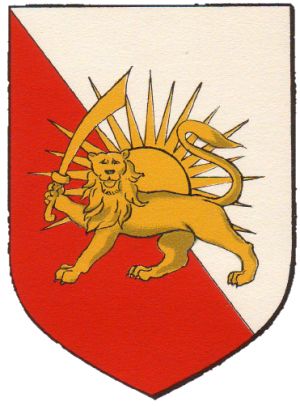
Years ago, I hiked through Switzerland’s Francophone countryside. When I passed through Chesalles-sur-Moudon, the village coat of arms caught my eye. At first, it looked like just another flourish in Europe’s heraldic landscape. But then I noticed the symbol at its center: a golden lion brandishing a scimitar beneath a blazing sun. This unmistakably Persianate cameo conjured the tiled palaces of Safavid Isfahan, the squares of Samarqand, and the imperial courts of Mughal Delhi. The lion’s share of the story behind it, I would learn, belonged to a globe-trotting local of these pastoral slopes.

Chesalles harbors an improbable link to the Persianate world: in 1927 the commune adopted a new blazon, the lion and sun, to honor an eighteenth-century native whose journey carried him from these verdant slopes to the Mughal court. His life—and the emblem that later memorialized it—offers a vivid window onto early modern mobility and the travels of symbols across continents.
Farr Far Away
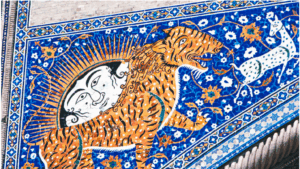
In Chesalles, the lion and sun, or Shir-o Khorshid, survives as a civic symbol—its former imperial clout spanning Iran, Central Asia, and South Asia now only a memory. Over centuries, the symbol accumulated layered meanings. The lion signified courage and worldly authority, while the sun radiated farr, the “glory” (ultimately from the Avestan “xᵛarənah”, lit. “good fortune”) believed to legitimize kingship.
From the era of the Turco-Persian Seljuqs onward, this dyad absorbed Islamic political theologies—including the association of the lion with ʿAli, known as Asadallah (lit. “the Lion of God”)—while preserving older Iranian conceptions of cosmic order. Standardized under the Qajars, it became one of the most recognizable emblems of Persianate kingship, legible from the Iranian plateau to the irrigated valleys of Transoxiana and the Gangetic plains.
To understand how the Shir-o Khorshid found a second life in Switzerland, we must turn to one remarkable micro-history of audacity and cross-cultural encounters: the story of Daniel Moginié. Born on 31 August 1710 in Chézals (as Chesalles was then spelled), he died on 22 May 1749 in Agra, during the turbulent reign of Ahmad Shah Bahadur (r. 1748-1754).
His brother François—a London-based innkeeper—later edited and published his swashbuckling brother’s biography, issuing it from 1754 onward under the title L’Illustre Païsan ou Mémoires et aventures de Daniel Moginié (The Illustrious Peasant: The Memoirs and Adventures of Daniel Moginié). The book found an avid readership, feeding the eighteenth-century appetite for travelogues, courtly intrigue, and stories from the exoticized “Orient”.

Following the publication of Moginié’s memoirs, later writers tried to impose a coherent “origin story” on a life that would carry him from rural Switzerland to Holland, the ports of Southeast Asia, and ultimately to Iran and Mughal India.
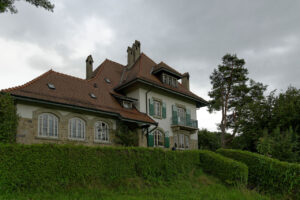
One of the most widely read versions of this story appeared a century later, in the Sydney Morning Herald of 23 June 1865, which presented a romanticized account of how his journey supposedly began. It claimed that, at about eighteen, a night of wine and family stories in the half-ruined ancestral home awakened his obsession with the Moginié family’s lost nobility.
A joking remark about some forgotten proof of that grandeur hidden “in a corner of the house” supposedly led him to break open a wall and discover a mysterious parchment. Taking this as a sign of destiny, Daniel enlisted in a Swiss regiment bound for Holland so that he could consult a professor in Leiden, then a rising center of philology.
From the Malay-Indonesian World to Persia and South Asia
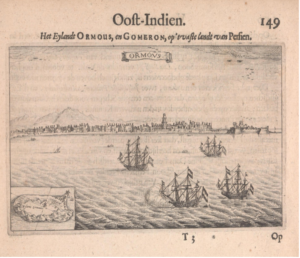
In Batavia, Moginié was caught up in colonial rivalries and intrigues that ended with his expulsion to Malacca, where a retired French officer urged him to abandon Southeast Asia and seek his fortune in Persia instead. Acting on that advice, he persuaded a ship’s captain in 1729 to put him ashore at Gamron, the port now known as Bandar Abbas, on the southern coast of Iran.
In Persia, Moginié entered the service of Nader Shah, the formidable Afsharid ruler, whose campaigns between 1736 and 1747 reshaped the political geography of Iran, Central Asia, and the Caucasus. Moginié reportedly served as a scout, an artillery officer, and a participant in the siege of Shiraz, where he was wounded. But the turbulence of Nader Shah’s later years—marked by palace intrigue and purges—eventually pushed Moginié to flee eastward toward Mughal India.
Delhi remained a symbolic center of Persianate sovereignty. Moginié’s Persian experience, coupled with the symbols he carried—including the lion and sun—seems to have impressed court officials. The Sydney Morning Herald claimed that in India Moginié rose to the rank of “Omrah” (i.e. ʿUmaraʾ, placing him among the empire’s high nobility) and held high offices, including the governorship of the Punjab and the supervision of the imperial household.
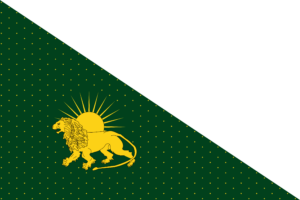
While the details are difficult to verify, his memoir and later accounts portray a broader arc that is consistent: Moginié was said to have lived in considerable splendor until his death in 1749.
A Swiss Odyssey and the Lion’s Share of a Legend
Drawing on his published travelogue, an 1865 article in the Sydney Morning Herald, titled “The Romance of a Swiss Boy,” embellished Moginié’s career, describing him as chamberlain and generalissimo to the Mughal emperor and as the husband of a wealthy princess who died childless, leaving him a vast fortune.
What began as a personal device encountered in Persia and India thus entered the visual language of a Swiss village, but it did so within a global order shaped by European expansion overseas. Switzerland had no formal colonies, yet Swiss soldiers, engineers, financiers, and merchants were deeply embedded in the imperial systems of others, from the Dutch East Indies to Mughal and post-Mughal India. Moginié’s career—part mercenary, part cultural cross-dresser, part self-mythologizer—belonged to this wider imperial world, even if it unfolded before the age of high empire.
Seen in this light, the Shir-o Khorshid on the coat of arms of Chesalles is more than a relic of distant courts. A Swiss adventurer claimed to have risen to power within Asian empires by mastering their political languages and symbols, and it was this version of him that the village chose to commemorate in 1927, at the height of European global dominance. The Persianate lion and sun thus records not only a remarkable journey, but a strategy of European authority abroad, in which foreign emblems were appropriated to legitimize rule.
Long before the British “White Mughals” of the nineteenth century, Moginié’s legend anticipated this imperial logic. The Shir-o Khorshid that crowns Chesalles records how a small Swiss village located itself inside a colonial world by adopting the symbols of Persianate power.

Discover more from Ajam Media Collective
Subscribe to get the latest posts sent to your email.


.svg)